


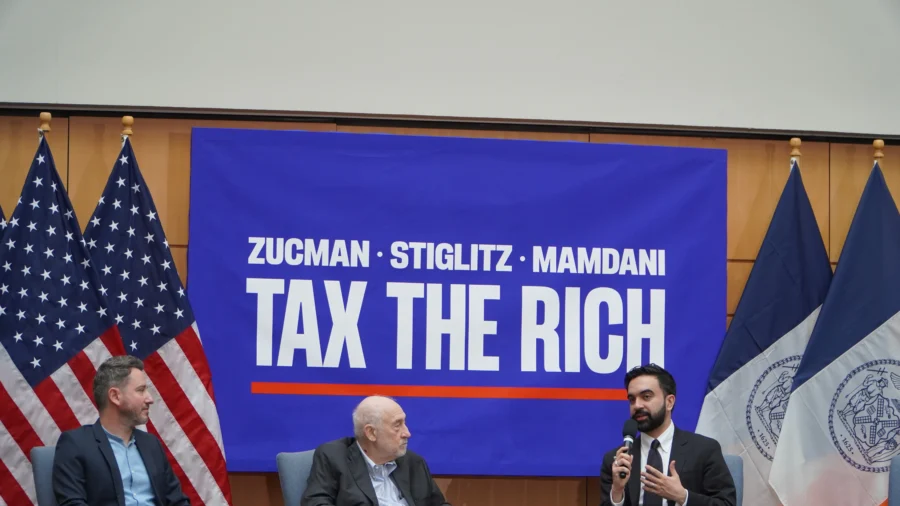
On Tax Day, New York City Mayor Zohran Mamdani hosted a public forum with two noted economists, calling for a tax on the “super-rich.”
The same day, the three men—Mamdani, Nobel laureate economist Joseph Stiglitz, and French economist Gabriel Zucman—co-signed a column in British newspaper The Guardian describing inequality as a "global crisis" and demanding that billionaires pay their "fair share."
The proposal is not new. Zucman, 39, has championed it since 2024, when he advised Brazil's G20 presidency on a global minimum tax for billionaires. He first rose to prominence in 2019, after Sens. Elizabeth Warren and Bernie Sanders folded his research on tax evasion into their presidential campaigns.
The Case for the Tax
At the forum, Mamdani, a democratic socialist, called for the "implementation of a 2 percent tax on wealth across the globe" as part of a "fight for a fairer world." Inequality, he argued, has "permeated politics through the five boroughs of our city, through our country, through the world."Stiglitz went further. Over "the last 25 years," he said, "41 percent of all the increase in wealth has gone to the top 1 percent," producing an "evisceration of the middle class" and "the growth of the oligarchy at the top."
Zucman framed the campaign as "the beginning of an international movement to finally make the super-rich pay their fair share," and described a confrontation between "democracy and oligarchy at the global level" as "the defining battle of the 21st century."
Zucman, who holds dual French-American citizenship, drew a historical parallel in an interview with The Epoch Times:
"The French Revolution abolished the privilege of the aristocracy. Today we need to abolish the tax privilege of our modern aristocracy: the billionaires, who pay much less tax than everybody else," he said.
At the forum, he urged the United States "to reconnect with its own tradition and its own history of using taxation," citing the progressive income and estate taxes as tools that should fund public goods but also "regulate inequality" and "protect and advance democracy." Extreme wealth, he argued, "is always an extreme power ... corrosive for democratic institutions."
A protégé of socialist economist Thomas Piketty, Zucman is one of France's polarizing figures. Critics call him "an activist of the extremist left," citing columns endorsing the economic programs of the New Ecological and Social People's Union and the New Popular Front, alliances co-led by far-left leader Jean-Luc Mélenchon's France Unbowed party, and noting that the EU Tax Observatory he directs is partly funded by George Soros's Open Society Foundations.
Critics: A Different Diagnosis
Nicolas Lecaussin, director of the Paris-based Institute for Research in Economic and Fiscal Issues (IREF), contested both the data and the conclusions in comments to The Epoch Times. The premise that a tiny elite captures most of the wealth, he argues, is one he has heard "for decades" from economists and journalists "fixated on the top 1 percent or even the top 0.1 percent."The general population has grown wealthier, not poorer, he says: The share of people living on less than $3 a day fell from 43 percent in 1990 to 10 percent in 2025, according to the World Bank.
"The increase in the number of billionaires has coincided with the decline of poverty worldwide," he said.
Lecaussin dismissed the symbolic weight of the 1 percent figure.
"If we want to be absurd, we could calculate how much a star footballer earns per minute on the field. It obviously means nothing," he said.
Entrepreneurs such as Mark Zuckerberg and Elon Musk, he adds, "create countless jobs" and "have revolutionized the world," benefiting above all the populations lifted out of poverty.
According to Zucman, in the 1960s, the 400 richest Americans paid about 50 percent of their income in taxes; today, it's around 24 percent, he says. The effective rate for French billionaires, he argues in his book "The Triumph of Injustice: How the Rich Dodge Taxes and How to Make Them Pay," runs to roughly 13 percent, lower than what the middle class pays.
Fresh figures reframe the debate, leading Lecaussin to conclude that "one cannot say that billionaires do not pay a large amount of taxes."
In the United States, IRS data for 2023, published April 15 by the Tax Foundation, show that the top 1 percent of filers now pay 38.4 percent of all federal individual income taxes, against 33.2 percent in 2001, on 20.6 percent of adjusted gross income. The bottom half of taxpayers earned 12.3 percent of AGI and paid 3.3 percent of federal income taxes. The top 1 percent contributed $823 billion, nearly as much as the bottom 95 percent combined.
As for France, a recent note from French tax authorities “found that the billionaires targeted by Zucman's proposal pay an average net income tax between 200 and 1,000 times higher than the average French taxpayer in absolute terms,” Lecaussin notes.
The most empirically testable claim concerns migration. Lecaussin warns that such a tax "would only accelerate the exodus of entrepreneurs," pointing to internal migration in the United States toward lower-tax states.
Zucman dismissed the concern as “propaganda.”
“This whole myth and threat of migration that’s used by the very wealthy to say, ‘No, no, no, you can’t tax us’ is never going to work,” he said, adding that the “overwhelming conclusion” of the research is that “absolutely nobody leaves.”
At the forum, Mamdani struck a similar note. As a state legislator, he said, he had confronted what he termed “the threat of an imagined exodus” that never materialized: New York now counts “more millionaires today than we did” before the previous tax on high earners.
IRS interstate migration data released in late March 2026, however, show that high-tax states continued to lose significant taxable income to low-tax states between 2022 and 2023. California lost a net $11.9 billion in AGI, New York $9.9 billion, Illinois $6 billion, and Massachusetts $4 billion. Florida gained $20.6 billion, Texas $5.5 billion, and Tennessee $2.8 billion, all states with no income tax. In Massachusetts, taxpayers earning more than $200,000 accounted for 70 percent of net outflows, roughly double their share before the millionaire surtax took effect.
To Stiglitz's claim of a vanishing middle class, Lecaussin counters with a recent American Enterprise Institute study: The middle class is shrinking not because families are falling out of it, but because they are moving up. The upper segment of the middle class rose from 10 percent of families in 1979 to 31 percent in 2024, while the lower middle class fell from 36 percent to 31 percent.
"Those who belonged to the middle class have not disappeared. They have simply become wealthier," he said.
For Lecaussin, the project is ideological. Karl Marx, he noted, advocated for a progressive income tax in the Communist Manifesto as a key instrument "for advancing the communist program in advanced capitalist countries." Zucman and his allies, he argued, "do not want more prosperity" but "a fairer society," which amounts to "leveling the classes": a Marxist project in substance.
Zucman turned the principle the other way.
"It is not radical to ask the super-rich to pay as much tax as the rest of the population," he said at the forum. "What is radical is to accept the current status quo, where they are allowed to live in their own parallel society, free of tax."