


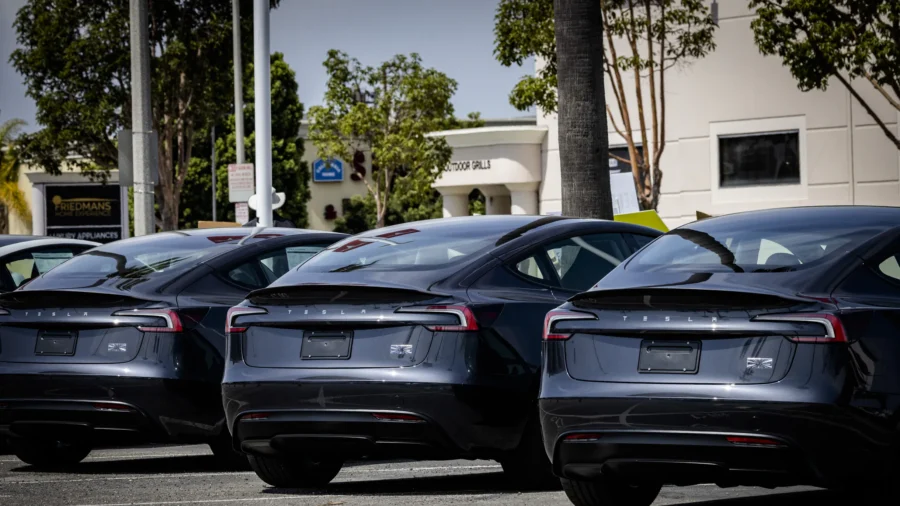
Tesla’s sales fell in the fourth quarter of 2025, as the company faces both intensifying global competition and the expiration of tax incentives for domestic electric-vehicle (EV) buyers.
For the full year, Tesla said it delivered 1,636,129 vehicles, the bulk of them Model 3 and Model Y cars. That marked an 8.5 percent decline from 2024 and the second consecutive year of annual sales contraction.
There were also signs that demand for the Cybertruck—Elon Musk’s much-hyped futuristic electric pickup—may have stalled. Tesla reported delivering just 11,642 vehicles in its “other models” category in the fourth quarter, which includes the Model S, Model X, and Cybertruck.
Tesla said it produced 434,358 vehicles in the quarter, a 5.8 percent year-over-year decline, and 1,654,667 vehicles in 2025, down 6.7 percent from the previous year.
Tesla’s results were also shaped by policy changes in the United States. The Trump administration’s decision to end a federal EV incentive by Sept. 30, which was years earlier than the original 2032 expiration date, pulled some demand into the third quarter as buyers rushed to purchase EVs before the $7,500 tax credit expired on Oct. 1.
Meanwhile, Tesla faces pressure from foreign competitors, notably China’s BYD. The Shanghai-based EV maker said on Jan. 1 that it sold 2.3 million electric cars globally in 2025, up 28 percent from 2024, marking its first year surpassing Tesla in annual sales.
A growing share of BYD’s sales came from markets outside China, including parts of Asia, Europe, and Latin America, while high tariffs have effectively barred Chinese EVs from entering the U.S. market.
Despite the disappointing performance in the EV sector, Tesla posted another strong quarter in its energy business. The company said it deployed 14.2 gigawatt-hours (GWh) of battery energy storage products in the fourth quarter, up from 12.5 GWh in the prior period.
Tesla’s energy-storage lineup includes backup batteries for homes as well as larger, utility-scale systems used by data centers and electric utilities.
The release of the fourth-quarter report did little to rattle Wall Street. Instead, the company’s shares continued to trade near record-high levels as investors focused on Musk’s ambitions in artificial intelligence and robotics, and on the belief that self-driving ride-hailing services could become Tesla’s next major growth engine.
In June 2025, Tesla launched a limited robotaxi pilot in Austin, followed a month later by a similar program in the San Francisco Bay Area. The service has typically operated with a human safety monitor in the vehicle who can intervene if something goes wrong.