



Import prices remained unchanged, following a downwardly revised 0.1 percent increase in August, reflecting higher nonfuel import prices offsetting lower fuel prices.
The market consensus for the delayed figures was 0.1 percent.
September saw a 1.5 percent drop in import fuel prices, driven by cheaper natural gas and petroleum, marking the index’s seventh month in a row of declines.
Excluding fuel, all imports rose 0.2 percent, up from 0.1 percent in the previous month.
Imported consumer goods, excluding motor vehicles, accounted for a large share of the increase, rising 0.4 percent. The jump was primarily observed in tariff-sensitive apparel and household goods.
Prices for imported capital goods fell 0.2 percent, while the price index for automotive vehicles was unchanged.
The latest trade data suggests foreign exporters did not lower their prices in response to the current administration’s sweeping global tariffs.
In August, President Donald Trump raised reciprocal tariff rates against many U.S. trading partners.
Prices for imports from China increased by 0.8 percent—the largest monthly gain since July 2008. Import prices from Japan rose 0.7 percent in September, the highest since January.
Goods prices from the European Union also ticked up 0.4 percent, while prices of Canadian products shipped to the United States dropped 0.8 percent.
Some of the increases also exhibited the U.S. dollar’s weakness against foreign currencies. A lower greenback can make imports more expensive and exports more competitive.
On a 12-month basis, import prices jumped 0.3 percent, up from the downwardly adjusted 0.1 percent decline in August.
Export prices were also flat in September, coming in below expectations. Export prices surged to 3.8 percent year over year, from a downwardly adjusted 3.2 percent.
Gauging the Trade Situation
Fresh data from U.S. ports follows the nation’s trade gap narrowing in August.The U.S. deficit clocked in at $59.6 billion from $78.2 billion in July, according to the Bureau of Economic Analysis.
Imports declined by 5.1 percent to $340.4 billion, and exports ticked up 0.1 percent to $280.8 billion.
Additionally, annual headline inflation in the G20 economies is projected to moderate to 2.9 percent in 2026 and 2.5 percent in 2027, from this year’s 3.4 percent.
Still, higher tariffs have yet to be fully realized and are beginning to appear in consumer spending and business costs, the report noted.
OECD Secretary-General Mathias Cormann urged countries to resolve trade tensions “given the fragilities in the global economy.”
Fiscal responsibility, says Cormann, is also crucial in today’s environment.
“Fiscal discipline is important to address increasing risks that arise from high public debt and higher spending needs due to defence requirements and population ageing,” Cormann said in a statement.
“Structural reforms that reduce red tape, simplify regulations and lower entry barriers in service sectors are key to enhance competition, innovation and business dynamism, and ultimately durably strengthen living standards.”
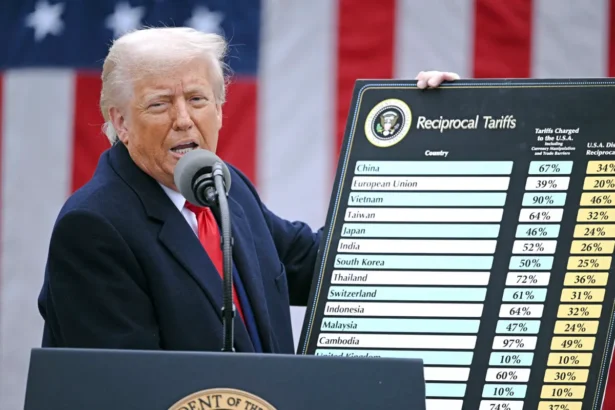
When Trump unveiled his chart of reciprocal tariff rates in April, the market was in a frenzy, economists warned of a global recession, and businesses rushed to ship goods across international waters.
The situation has stabilized since.
“When that tariff chart was unveiled in the Rose Garden, it caught many off guard, and the market plunged as tariffs were far greater than expected. Since then, much of those initial tariffs were walked back, and we never did get 100 deals in 100 days,” Jay Woods, chief market strategist at Freedom Capital Markets, said in a note emailed to The Epoch Times.
“However, what we learned was that the market spoke loudly and Washington listened.”
Although levies have begun to appear on various tariff-sensitive goods, inflation has not spiraled out of control.
While businesses are reporting increased expenses, the pass‑through of rising input costs to customers differed depending on demand, competition, consumer sensitivity, and client pushback.
“Looking ahead, contacts largely anticipate upward cost pressures to persist, but plans to raise prices in the near term were mixed,” the Beige Book stated.