


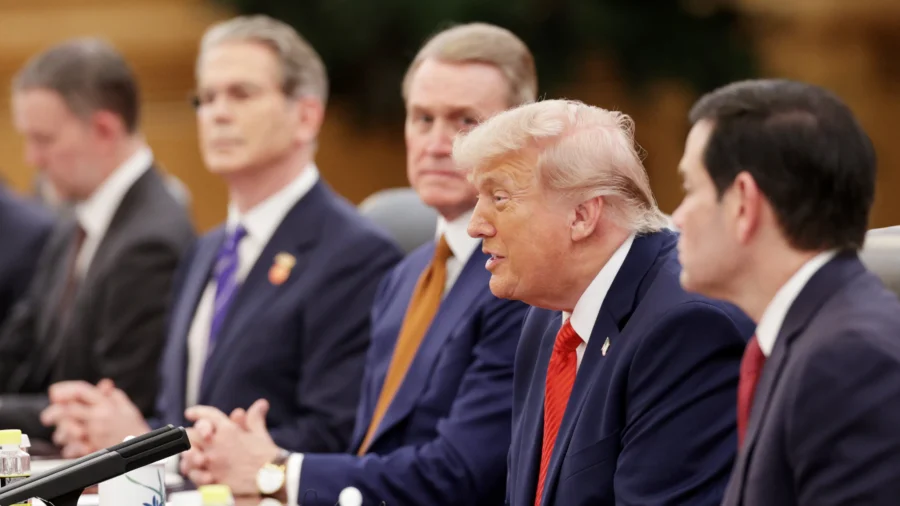
Chinese leader Xi Jinping has pledged not to provide military equipment to Iran, President Donald Trump said after the first day of talks between the two leaders in Beijing.
"He said he's not gonna give military equipment," the president told Fox News' Sean Hannity in an interview on May 14. "That's a big statement."
Trump’s comments come amid growing allegations that China has quietly supported Iran’s military capabilities through dual-use technologies, industrial materials, and covert supply networks.
In a May 10 interview on CBS’s “60 Minutes,” Netanyahu said China had provided Iran with “a certain amount of support” and “particular components of missile manufacturing” when asked whether Beijing was offering “materially valuable military support” to Tehran.
“But I can’t say more than that,” Netanyahu added.
His remarks followed a series of U.S. sanctions targeting China-based entities accused of assisting Iranian military operations. The U.S. State Department recently sanctioned several companies allegedly involved in supplying satellite imagery that helped facilitate Iranian strikes against U.S. forces during Operation Epic Fury.
Earlier this year, the Treasury Department also imposed sanctions on Chinese companies and individuals accused of helping Iran’s Islamic Revolutionary Guard Corps obtain ingredients used in ballistic missile propellants.
Analysts say the actions point to a broader strategy by the Chinese Communist Party (CCP): avoiding open military alignment with Iran while quietly sustaining Tehran’s military-industrial infrastructure.
“The design of Iran’s entire network of underground tunnels was executed by the military engineering division of the CCP’s military,” Chinese legal scholar and political writer Yuan Hongbing, who lives in exile in Australia, told The Epoch Times.
“Furthermore, the critical high-tech components for Iran’s missiles and drones were all supplied by the CCP,” he said.
According to Yuan, Beijing has attempted to maintain a low-profile role while publicly presenting itself as a global advocate for peace.
Netanyahu’s comments also echo earlier statements made by Trump in April, when he suggested China may have helped Iran replenish military supplies during a temporary ceasefire.
“We caught a ship yesterday that had some things on it, which wasn’t very nice—a gift from China, perhaps,” Trump told CNBC on April 21.
He added that Iran had “done a little bit of restocking” during the pause in fighting.
Additional concerns focus on China’s role in supplying industrial equipment and technologies vital to Iran’s missile production.
Israeli security officials told Epoch Magazine in Israel that Iran resumed purchasing planetary mixers from China after Israeli strikes severely damaged Tehran’s solid-fuel missile manufacturing infrastructure during the 12-day conflict in June 2025.
The industrial mixers are used to combine compounds for solid rocket fuel and are considered difficult to replace, making them a critical part of Iran’s missile production chain.
Solid-fuel missiles are especially important to Iran because they can be launched quickly without pre-launch fueling, reducing the risk of launch sites being targeted before firing. Israeli officials have viewed the Chinese-supplied mixers as strategically significant enough to repeatedly target during operations against Iran’s precision missile program.
A report by the U.S.–China Economic and Security Review Commission also found that Chinese-made sensors, semiconductors, and voltage converters have appeared in Iranian drones used by Tehran-backed proxy groups.
While China was a major supplier of conventional weapons to Iran during the 1980s, the commission noted that cooperation has increasingly shifted toward dual-use technologies and defense-related systems tied to missile and drone development.
The commission further reported that two Iranian vessels departed a Chinese port in March carrying sodium perchlorate, a key ingredient used in solid rocket fuel. It cited a similar January shipment involving roughly 1,000 tons of the chemical loaded onto Iranian-linked ships in China.
In April 2025, the Treasury Department sanctioned six entities and six individuals in Iran and China accused of procuring missile propellant materials for the Islamic Revolutionary Guard Corps, including sodium perchlorate and dioctyl sebacate, another substance used in solid-fuel rockets.
At the time, Treasury Secretary Scott Bessent said Iran’s missile development program “imperils the safety” of the United States and its allies.