


Congressional leaders failed to reach an agreement on a stopgap spending resolution that would avert a government shutdown at 12:01 a.m. on Oct. 1.
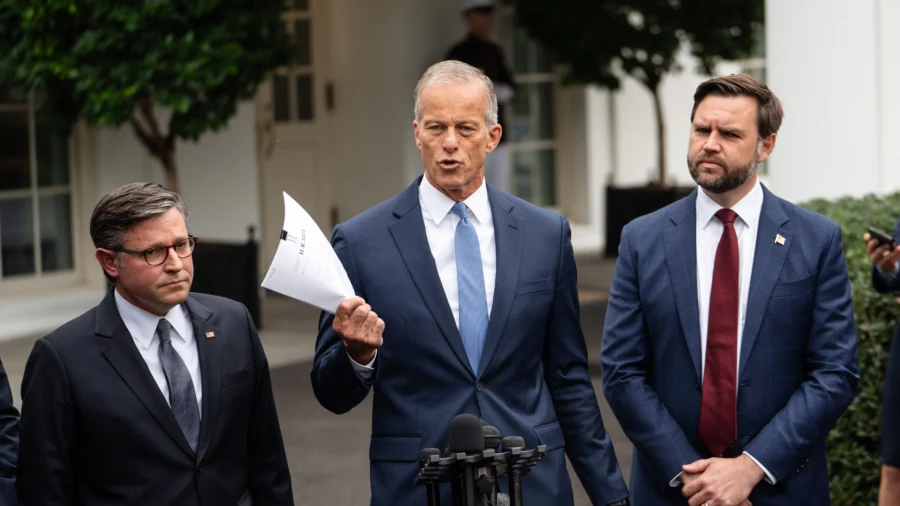
House Speaker Mike Johnson (R-La.), House Minority Leader Hakeem Jeffries (D-N.Y.), Senate Majority Leader John Thune (R-S.D.), and Senate Minority Leader Chuck Schumer (D-N.Y.) met with President Donald Trump on the afternoon of Sept. 29 but remained deadlocked as Democrats continued to demand significant additional spending on health care in exchange for their votes.
"We have very large differences on health care," Schumer told reporters as he emerged from the White House conference. "[Trump] can avoid a shutdown, but there are still large differences between us."
Jeffries said: "Democrats are fighting to protect the health care of the American people, and we are not going to support a partisan Republican spending bill that continues to gut the health care of everyday Americans. Period. Full stop."
Republicans have said that a seven-week, continuing spending resolution should not be used as a substitute for the appropriations process, which involves agreement in both houses of Congress on a dozen individual spending bills.
Vice President JD Vance rejected Democrats' use of health care policy disagreements as leverage in shutdown talks.
"We think that's preposterous," Vance said.
The vice president said that Republicans were willing to work to find a solution to health care issues, but not now.
"You don't shut the government down," he said.
Schumer said he had made some proposals to Republican leaders, but he did not say what they were.
He instead outlined what he called the consequences of not taking action, including rural hospital closures, cuts to Medicaid, and a dramatic increase in health insurance premiums for working people.
Democrats have also asked for an extension of enhanced premium tax credits, which are COVID-19-era subsidies for middle-income Americans who purchase health insurance through the Affordable Care Act, otherwise known as Obamacare.
The enhanced credits for about 20 million people in households earning more than four times the federal poverty level expire on Dec. 31.
The crux of the disagreement is that Republicans want to extend current spending levels for the next seven weeks while Congress continues to work on the 12 appropriations bills required to fund the federal government next year.
To pass a continuing resolution, Republicans, who hold 53 seats in the Senate, need at least seven votes from Democratic or independent senators.
The House passed a so-called "clean" continuing resolution—a bill that temporarily extends government funding at current levels without additions—on Sept. 19, but the measure failed in the Senate by a 44–48 vote. Sen. Lisa Murkowski (R-Alaska) joined all Democrats and independents in opposing the resolution. Eight Republicans did not vote.
“We are willing to sit down and work with them on some of the issues they want to talk about,” Russell Vought, director of the Office of Management and Budget, said, specifically mentioning the extension of enhanced premium tax credits.
During an appearance on “Meet the Press” on Sept. 28, Thune criticized Democrats for bogging down a simple continuing resolution.
“This is a simple, seven-week funding resolution to allow us to do a normal appropriations process,” he said. “We’re trying to do appropriation bills in the old-fashioned way.”
Congress has not agreed on the 12 appropriations bills since 1997. In most years, Congress has resorted to a series of short-term continuing funding resolutions throughout the fall, followed by a single omnibus spending bill made up of all spending decisions passed late in the calendar year.
No appropriations bill has passed both houses of Congress yet this year.