

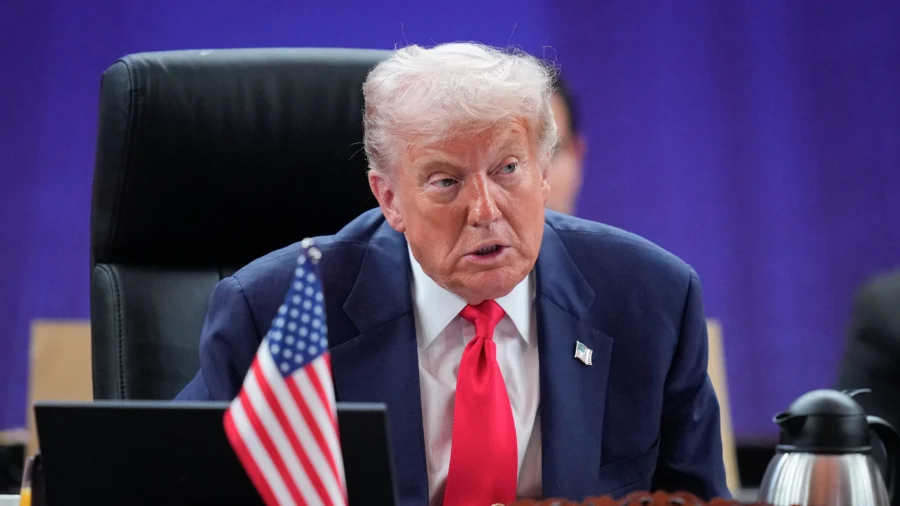
Before the anticipated high-stakes meeting with Chinese leader Xi Jinping, President Donald Trump revealed more details and hoped it could last "three to four hours."
Trump arrived in South Korea today for the summit's final leg, expressing strong optimism about the outcome of the pair's meeting.
In remarks at the Asia-Pacific Economic Cooperation (APEC) CEO Summit in Gyeongju, South Korea, Trump addressed business leaders that he was confident he would be able to strike a "good deal" with Xi.
Trump was also overheard on a hot mic as he took his seat for the meal, saying that his upcoming meeting with Xi would run for three to four hours.
"We're going to have something that's going to be very, very satisfactory to China and to us. I think we're gonna have a—I think it's going to be a very good meeting. I look forward to it tomorrow morning when we meet," Trump said.
The meeting, on the sidelines of the APEC summit in Busan, will be their first face-to-face encounter since 2019—and also Trump's first with Xi during his second term.
Fentanyl Tariffs, Rare Earths, and Soybeans
On Oct. 28, Trump revealed that fentanyl-related tariffs, rare earth exports, and U.S. farmers were among the agenda items for his meeting.Trump had imposed a 20 percent tariff early in his second term to pressure Beijing into curbing the export of precursor chemicals. “I expect to lower that tariff because I believe they will help us with the fentanyl situation,” Trump said. “We have to get rid of it.” However, he did not specify what measures China would take to curb the flow of fentanyl precursors.
When asked if Beijing's potential one-year delay on implementing rare earth export controls would suffice to secure further U.S. concessions, Trump replied, “We haven’t talked about the timing yet, but we are going to work out something.”
In an ABC News interview on Oct. 26, Treasury Secretary Scott Bessent said that China had “threatened to put a global export licensing regime, and I believe that they are going to delay that for a year while they reexamine it.”
During his Asia tour, Trump negotiated and signed a series of bilateral and multilateral agreements with Japan, Malaysia, Thailand, Vietnam, and Cambodia to secure alternative, reliable, and resilient non-Chinese supply chains.
Trump also made the resumption of Chinese purchases of U.S. soybeans another key demand. On Oct. 19, he told reporters: “I want [China] to start buying soybeans at least in the amount that they were buying before. And I believe they'll be able to do that.”
Benchmark Chicago soybean futures prices jumped this week to their highest in 15 months, rebounding from recent five-year lows on hopes for a U.S.-China trade deal.
U.S. firm's high-end AI chips are another key sticking point in protracted trade talks with China. Trump said on Wednesday he will speak to Xi about Nvidia's Blackwell artificial intelligence chip.
Speaking to reporters aboard Air Force One en route to Gyeongju, South Korea, Trump praised Nvidia's current flagship Blackwell model as the "super-duper chip" and said he might speak to Xi about it, without giving any details.