

President Donald Trump said Israeli and Lebanese leaders will speak for the first time in decades, adding that he is pushing for “breathing room” despite the intensifying conflict.
“It has been a long time since the two leaders have spoken, like 34 years. It will happen tomorrow. Nice!” Trump wrote in a April 16 Truth Social post.
Israel’s security cabinet discussed a potential ceasefire in Lebanon last night, but no decision was made.
A senior Israeli political official told Epoch Magazine Israel that after a four-hour discussion on the issue, it appears that despite the reports in Lebanon about a ceasefire, there is currently no movement in that direction.
In an April 16 post on X, the Lebanese Presidency said President Joseph Aoun had told UK Middle East minister Hamish Falconer that “the ceasefire that Lebanon is demanding with Israel will be the natural entry point for direct negotiations between the two countries,” under a presidential initiative.
Aoun said Lebanon was seeking to “halt the escalation in the south and in all Lebanese regions so that the targeting of the innocent … ceases,” while adding that “the negotiations are to be undertaken by the Lebanese authorities alone,” calling it a matter of sovereignty.
He added that the withdrawal of Israeli forces would be an “essential step” to consolidate any ceasefire, alongside deploying the Lebanese army to the border and ending “any manifestations of armed presence.”
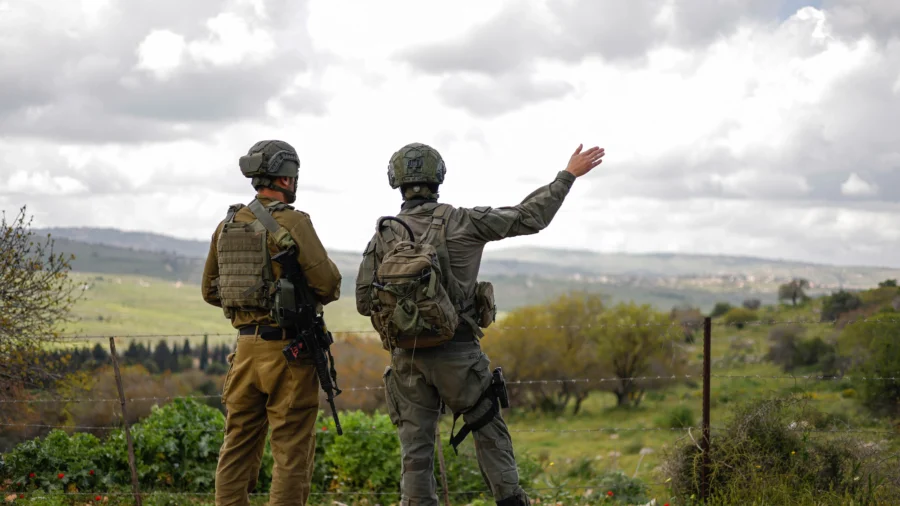
The discussions come as Israel is already in the midst of operations beyond Iran. Trump announced a two-week ceasefire in the six-week Iran war on April 7.
On April 16, an Israeli strike severed the last bridge linking southern Lebanon to the rest of the country, a senior Lebanese security official told Reuters, adding that the strike “shattered” the bridge and left no possibility of repairing it.
“All sides agreed to launch direct negotiations at a mutually agreed time and venue,” the U.S. State Department said in a statement after the talks.
Rubio said the meetings were not just about reaching a ceasefire between Israel and Lebanon, but about marginalizing Hezbollah.
It states that Hezbollah is a partner force of the Iranian regime, helping Tehran “project power across the region, train allied militias (reportedly including Hamas), threatening U.S. interests and allies across the region.”
It notes that Hezbollah has used Israel’s presence in the Shebaa Farms and other disputed areas in the Lebanon–Syria–Israel tri-border region to justify ongoing violence against Israel.
“This is about bringing a permanent end to 20 or 30 years of Hezbollah’s influence in this part of the world,” Rubio said in comments ahead of the April 14 talks.
That meeting—which included Israeli Ambassador to the United States Yechiel Leiter and Lebanese Ambassador to the United States Nada Hamadeh Moawad—marked the first time since 1993 that the Israeli and Lebanese governments had openly engaged in direct diplomatic talks.
In an interview with Fox News that aired on April 15, Trump said the United States would not agree to any deal with Iran unless Tehran abandons its nuclear ambitions.
“Well, first of all, if they don’t, we’re not making a deal,” Trump said.
He said that the key objective of U.S. policy regarding Iran remains unchanged.
“This whole thing is really about no nuclear; they cannot have a nuclear weapon,” Trump said.