


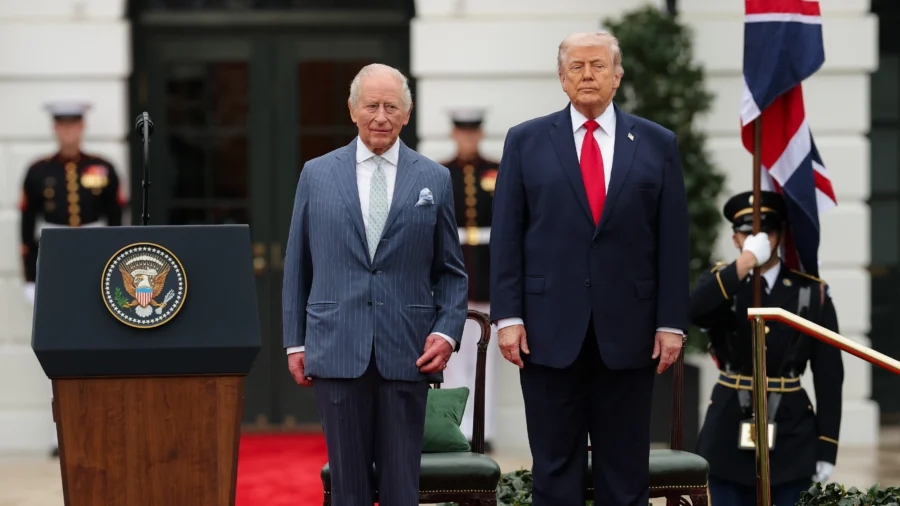
President Donald Trump lifted the spirits of the whiskey industry after confirming he would remove tariffs and restrictions to bolster Scotland–Kentucky relations.
Last year, the president imposed a 10 percent baseline tariff on most British goods, including Scottish whiskey imports.
Both sides of the Atlantic have been heavily affected, with shipments declining by double digits.
In honor of this week's visit by the UK's King Charles III and Queen Camilla, the president said in an April 30 Truth Social post that tariffs and restrictions on whiskey will be eliminated.
"People have wanted to do this for a long time, in that there had been great Inter-Country Trade, especially having to do with the Wooden Barrels used," Trump said.
“The King and Queen got me to do something that nobody else was able to do, without hardly even asking.”
King Charles visited Trump this week as part of a four-day U.S. state visit commemorating the 250th anniversary of American independence and reaffirmed U.S.–United Kingdom relations.
Chris Swonger, president and CEO of the Distilled Spirits Council, welcomed Trump's decision.
"The removal of the 10 percent tariff on UK whisky would be a major victory for American hospitality businesses that are deeply impacted by international trade," Swonger said in a statement to The Epoch Times.
"The United States and the United Kingdom share a deep and enduring spirits tradition built on generations of craftsmanship, agriculture and market access. We applaud President Trump for working to restore a proven zero for zero model of fair, reciprocal trade between our two nations," he continued.
"This action strengthens transatlantic ties, brings much needed certainty to our industry and allows spirits producers on both sides of the Atlantic to grow, invest and support jobs at a critical time.”
The Scottish Whiskey Association also expressed gratitude for the decision.
"This deal is a significant boost for the Scotch Whisky industry in our most valuable export market. Distillers can breathe a little easier during a period of significant pressure on the sector," Mark Kent, the group's chief executive officer, said in a statement.
"While challenges in our sector remain, we can now redouble our efforts to boost the benefits our two great industries bring to communities across Scotland and the United States."
Figures from the Scottish Whiskey Association indicate shipments to the United States declined by 15 percent between May and December 2025.
Likewise, exports of U.S. whiskey fell 19 percent last year to $1.1 billion, according to the Distilled Spirits Council of the United States, in a March 31 report. Overall shipments of U.S. spirits fell almost 4 percent to $2.37 billion, fueled by lower exports to Canada and the European Union.
Kentucky's bourbon industry has suffered immensely, losing approximately $250 million and seeing more than 16 million barrels in inventory.
U.S. shares of Diageo, a British multinational alcoholic beverage company headquartered in London, surged 4 percent after the announcement. Shares of Brown-Forman, parent company of Jack Daniel’s, also jumped nearly 3 percent in the final trading session of the month.
Alcohol has previously been involved in the president’s efforts to rebalance trade with major U.S. partners.
Tariff Refunds Coming
The administration has not announced any new major trade decisions this week.Shortly after the Supreme Court blocked the president's use of the International Emergency Economic Powers Act—also known as IEEPA—to implement sweeping global tariffs, Trump imposed a universal 10 percent tariff under Section 122 of the Trade Act of 1974.
This measure allows the White House to move ahead with tariffs of up to 15 percent on foreign goods entering the United States for up to 150 days.
In the meantime, the federal government will issue the first set of refunds for Trump's invalidated tariffs on or about May 11, according to new documents from the U.S. Court of International Trade.
“Importers and authorized brokers should anticipate that valid IEEPA refunds will generally be issued within 60 [days to] 90 days following acceptance of the CAPE declaration, unless a compliance concern requires further CBP review, ” the agency stated on its website.
“However, certain scenarios, such as entries that are extended, suspended or under review, and warehouse entries, will maintain their liquidation status with validated refunds issued at liquidation.”