

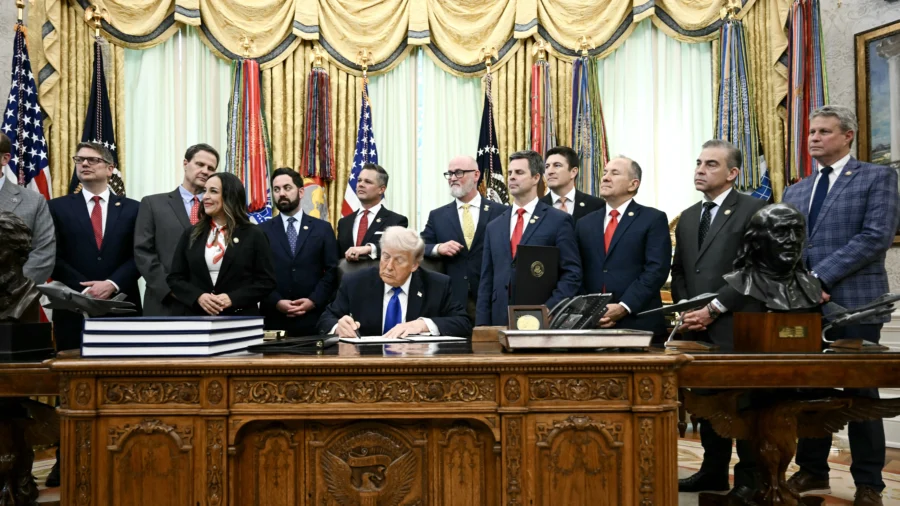
President Donald Trump signed an executive order Thursday that seeks to address longstanding problems in the federal government's contracting system, citing “unpredictable costs,” “bloated overhead,” and weak performance incentives that have driven up spending and reduced accountability.
In a new policy directive, officials said the current model has too often failed to protect taxpayer dollars or ensure contractors deliver on time.
“Federal procurement has for too long tolerated unpredictable costs, bloated overhead, and weak performance incentives that frequently allow overspending,” the executive order stated. “Many government contracts operate on a cost-reimbursement model that guarantees reimbursement for incurred costs plus a profit margin, which provides little incentive to control overspending.”
A review of federal spending found roughly $120 billion in fiscal year 2024 was obligated under such cost-reimbursement consulting contracts. Officials said the model doesn’t create much of an incentive to control spending.
The Trump administration is pushing agencies to rely more heavily on fixed-price contracts, which set a defined cost for specific outcomes and tie contractor profit to performance. The directive says that shifting toward performance-based contracting would improve cost predictability, strengthen accountability, and reduce the risk of overspending.
A Government Accountability Office (GAO) review published in September 2025 found that contractors managing National Nuclear Security Administration sites did not follow key best practices when estimating costs for fixed-price construction subcontracts.
None of the seven contractors reviewed met all 12 steps outlined in GAO’s cost-estimating guidance, which is designed to ensure estimates are comprehensive, accurate, and reliable.
The analysis also found that contractors routinely underestimated project costs. Reviewing 252 subcontracts completed in fiscal year 2023, GAO found final costs exceeded initial estimates by more than $37 million, or about 14 percent.
Most overruns occurred after contracts were awarded. Although fixed-price contracts are intended to limit government exposure to rising costs, GAO found that changes in project scope and unexpected expenses still drove increases, with costs sometimes shared by both the government and contractors.
In May 2025, the Department of Defense’s Inspector General released a report that found recurring weaknesses in how the Pentagon oversees its massive contracting operations. The report said the Department of Defense had “inadequate contract oversight.”
The report warned that these oversights increase the risk of waste, overpayments, and contractors failing to meet obligations.
The Department of Defense is the world’s largest purchaser of goods and services. In fiscal year 2024, it had $1.4 trillion dedicated to contractors for services such as weapon systems, spare parts, fuel, maintenance, and health care.