


President Donald Trump announced on March 6 that he would sign an executive order within a week that would rein in the unrestricted name, image, and likeness spending in college football.
“I will have an executive order within one week, and it’ll be very effective,” he said. “It’ll be very necessary for college, and we’re going to put it forward, and we’re going to get sued, and we’re going to see how it does.”
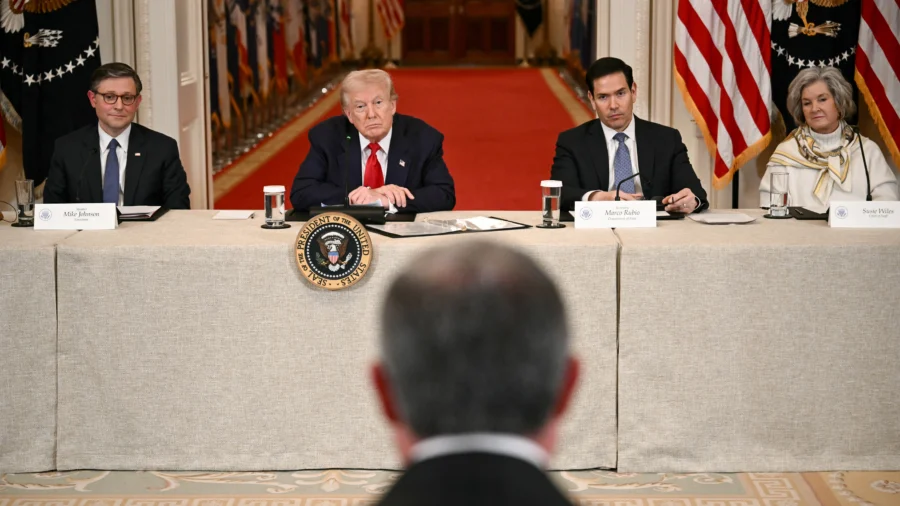
He convened a roundtable at the White House with state and federal lawmakers, as well as sports agents and leaders in professional, college, and Olympic athletics, to gather input on the best way forward to impose nationwide standards surrounding athletic benefits and eligibility.
The goal was to figure out a solution as soon as possible.
“This isn’t just about student athletes,” the president said. "This is about our whole educational system. It is going to go out of business because of this.”
Since the United States District Court for the Northern District of California’s ruling in NCAA v. Alton in 2021 found restrictions on student athletes’ ability to earn compensation from their name, image, and likeness unlawful, colleges entered what the president described as a “financial arms race” to offer prospective players more and more money in what are called NIL—name, image, likeness—deals.
Lawmakers and athletic professionals also pointed out this increasing financial burden, with some schools posting hundred-million-dollar losses. The drive to have competitive football programs is also causing funding to be repurposed from other sports, ultimately resulting in the cancellation of their programs. This funding issue is primarily affecting women's sports programs and sports programs known for producing hundreds of America’s Olympic athletes.
“Every day, I got asked for more money for NILs,” Randy Levine, President of the New York Yankees, said at the meeting. “Every single day. And what happened is I gave money for an NIL for a quarterback who left the next year."
"Meanwhile, a friend of mine's daughter is on the rowing team, and she lost her scholarship, and she's an Olympic hopeful, and now she has to pay her own way,” he said. "That's just not right.”
Sarah Hirshland, CEO of the United States Olympic Committee, noted that athletes at the Summer Olympic Games in Paris represented more than 230 different colleges and 71 athletic conferences. Team USA’s medalists alone represented 90 different schools.
“One of our competitive advantages is the education-based sport system our country has embraced for more than a century,” she said. “America’s colleges and universities built a world-class athletic system that develops the whole athlete academically and competitively.”
Since that court ruling, roundtable participants also noted that it had become more and more common for student athletes to transfer from one school to another after just a single season and remain eligible far beyond the traditional four-year stint.
Nick Saban, former head football coach for the University of Alabama, pointed out that the lack of eligibility restrictions had 25- and 26-year-olds playing against 18- and 19-year-olds.
Saban also emphasized the need to put education back at the forefront of the student athlete’s experience, providing them an opportunity to advance themselves beyond athletics.
Trump celebrated the United States’s college athletic tradition, stating, “No other nation in the world has built a system that develops champions in classrooms and on the field, producing Olympic heroes, professional legends, and the leaders of tomorrow all at once.”
However, Trump said he was going to draft and sign an executive order with the help of the leaders present due to his doubt that enough Democratic lawmakers would be convinced to support the legislation. Johnson would continue to work on the SCORE Act in the meantime, and Trump added that he could put his executive order before Congress to be codified.
Still, Charlie Baker, President of the NCAA, said that there was still a lot that was right with college sports. He noted that there were more youngsters playing college sports than at any other time in the nation’s history, and the visibility of women’s sports had grown drastically. He also praised work underway with the SCORE Act to make college athletics even better.
“We should do all we possibly can to ensure its success for the next generation and the generations after that,” he said.