

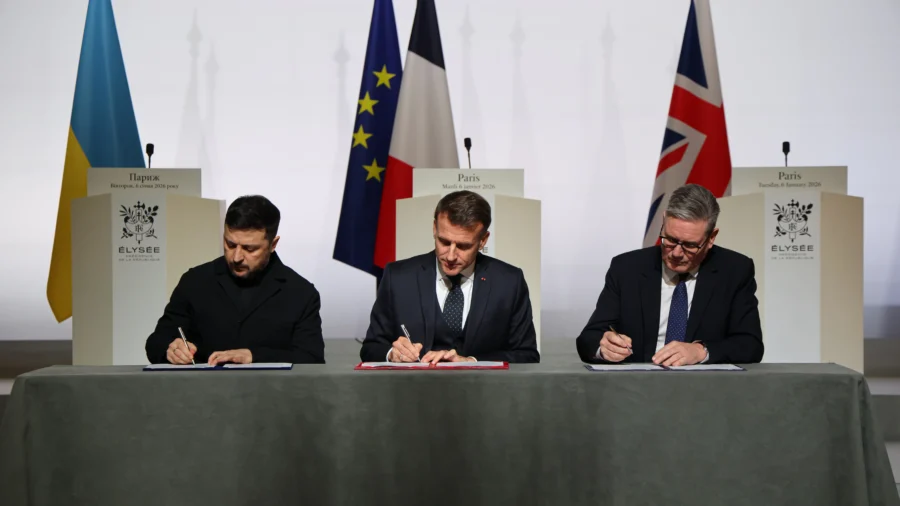
British Prime Minister Keir Starmer, French President Emmanuel Macron, and Ukrainian President Volodymyr Zelenskyy inked the document confirming the intention in Paris after talks involving the members of the “Coalition of the Willing” and envoys from Washington.
He later told France 2 TV: “We’ve expressed our availability to be deployed in this multinational force. These are not combat forces, I want to clarify that for our fellow countrymen. It’s for the day after there’s peace, offering a guarantee of peace and security.
“That’s potentially thousands of men. But it’s not, first of all, for right now. Second of all, it will be part of a plan. And finally it will be part of our existing foreign operations.”
Starmer told the British Parliament in London on Jan. 7 that any deployment of UK forces under a declaration signed with France and Ukraine would be subject to a vote by MPs.
“I will keep the house updated as the situation develops, and were troops to be deployed under the declaration signed, I would put that matter to the house for a vote,” he said.
Allies also backed a proposal to provide Ukraine with multilayered security guarantees after any cease fire or peace settlement.
A joint statement said Kyiv’s armed forces would remain “the first line of defense and deterrence,” with partners committing to long-term military assistance even after hostilities cease.
Zelenskyy’s top adviser said on Jan. 7 that “concrete results” had been achieved as talks in Paris on peace and security guarantees for Ukraine continued into the second day.
“Ukrainian national interests will be defended.”
After the summit, Witkoff said that Trump “strongly stands behind security protocols.”
“Those security protocols are meant to … deter any attacks, any further attacks in Ukraine, and … if there are any attacks, they’re meant to defend, and they will do both,” Witkoff, who has led talks with Russia, said at a joint news conference with French, German, British, and Ukrainian leaders.
Kushner said that if Ukrainians were to make a final deal, “they have to know that after a deal they are secure, they have, obviously, a robust deterrence, and there’s real backstops to make sure that this will not happen again.”
In a post on X, Zelenskyy said that his top negotiator, Rustem Umerov, had delivered an initial report on the work of the Ukrainian team in France.
“Another session of talks with envoys of the President of the United States will take place, and this will already be the third such session in two days,” he said.
“We expect, in particular, that the most difficult issues from the basic framework for ending the war will be discussed—namely, issues related to the Zaporizhzhia Nuclear Power Plant and territories. I also instructed the team to discuss possible formats for leader-level meetings between Ukraine, other European states, and the United States.”
He added that he expected to have a detailed report on the state of negotiations “by the end of the day.”