
UK Seeks FIFA Probe Over Argentina's Falklands Banner After England World Cup Defeat

Prime Minister Keir Starmer backed calls for FIFA action after Argentina players unfurled a Falklands banner, while President Javier Milei defended the display.
Published: 7/17/2026, 5:54:35 AM EDT
UK Seeks FIFA Probe Over Argentina's Falklands Banner After England World Cup Defeat
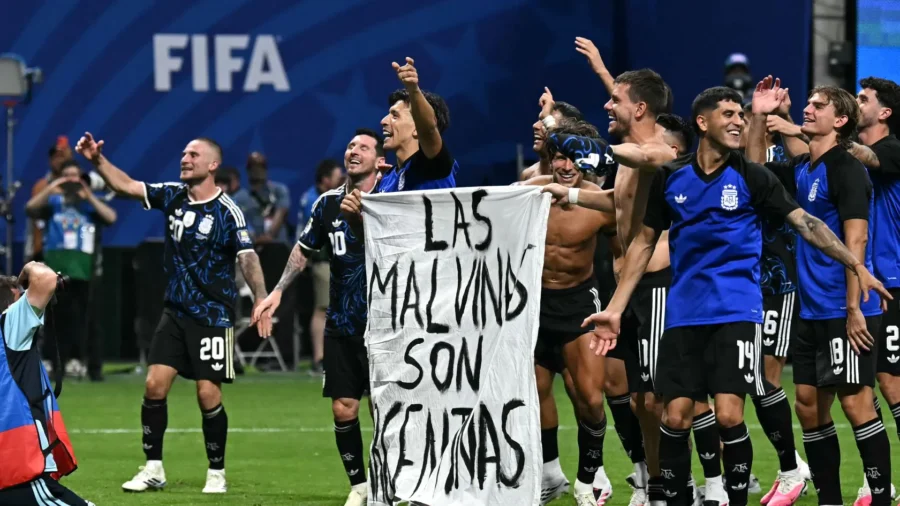
Argentina's players hold a banner reading, when translated into English, "The Malvinas (Falkland Islands) belong to Argentina," after winning the 2026 World Cup football tournament semi-final match between England and Argentina at the Atlanta Stadium in Atlanta on July 15, 2026. (Paul Ellis/AFP via Getty Images)

The United Kingdom has called for a FIFA investigation after members of Argentina's national soccer team displayed a banner asserting the Falkland Islands belong to Argentina following its World Cup victory over England.

After Argentina's 2-1 comeback win over England on Tuesday, some Argentinian players held up a banner that said "Las Malvinas son Argentinas." The Falklands remain a subject of ongoing international tension between the two nations following the 1982 Falklands War. Outgoing UK Prime Minister Keir Starmer demanded that FIFA investigate the team for violations of federation rules.

“The World Cup might not be ours, but the Falkland Islands definitely are,” a spokesperson for Starmer said Thursday. “Self-determination rests with the islanders and our commitment to the Falklands will never waver.”

Starmer supported calls for FIFA to investigate, the spokesperson said, after U.K. Secretary of State for Business and Trade Peter Kyle said the players’ behavior was “entirely inappropriate.”

Kyle told the BBC “politics needs to be separate from football.”

“In fact, the World Cup has one of its central tenets that politics is separate from football,” he said. “That is now a matter for FIFA.”

Argentine President Javier Milei described the players’ celebration with the banner as “perfectly valid,” saying the message “reflects a sentiment shared by all Argentines.” But he said he expected FIFA to fine the team.

“What the players do is understandable; they get carried away by their emotions, they act on impulse, and that will likely lead to discussions about a fine,” Milei told a local Buenos Aires radio station.

The Falkland Islands Legislative Assembly also sent a letter to the FIFA Disciplinary Committee on Thursday, asking the federation to investigate the display for violations of FIFA rules.

"We are disappointed, though regrettably not surprised, by this manner of action," Jack Ford, chair of the assembly, wrote.

"Football is, first and foremost, a sport, and it is the policy of the Falkland Islands Government to wish to not see politics brought into sport, and we support the statement by U.K. Minister Peter Kyle to this effect."

FIFA rules prohibit "the use of gestures, words, objects or any other means to transmit a message that is not appropriate for a sports event, particularly messages that are of a political, ideological, religious or offensive nature."

The fine for a violation of those rules ranges from $5,000-$10,000 for a first offense; fines for a second offense range from $10,000-$20,000; the fine doubles for each further offense.

There has been a previous offense. Argentine players displayed the same message during a warm-up game for the 2014 World Cup, and FIFA imposed a fine of 30,000 Swiss francs (about $37,000).
The islands are the subject of a centuries-long sovereignty dispute between the two countries. The U.K. claims the Falklands as sovereign British territory, citing its administration since 1833. Argentina claims the islands—which sit some 300 miles east of its mainland and which it refers to as the "Islas Malvinas"—as its own by succession to Spanish colonial rights upon gaining independence from Spain in 1816. The dispute escalated into a 10-week armed conflict in 1982, with the U.K. emerging victorious.
The Associated Press contributed to this report.