


This brings the total direct funding for the Department of State’s Ebola response to more than $200 million.
"The Notes from the Field report documents this outbreak—which was first detected among clusters of healthcare workers—and has grown to be the largest Bundibugyo outbreak on record. It explains why containing this outbreak requires sustained resources and sustained attention," Pillai said.
Jason Asher, director of the CDC's Center for Forecasting and Outbreak Analytics, said that there could be over 20,000 cases of Ebola over the next three month in which only 20 percent of cases isolate within two days, according to modeled scenarios.
"So those would be substantially very large outbreaks, and there are simulations that do exceed that over a longer period of time," Asher said.
The strain driving the outbreak is the Bundibugyo virus—pronounced "Bun-dee-BOO-joh"—one of four types of orthoebolaviruses capable of causing Ebola disease in humans. There is no vaccine for the Bundibugyo strain, and treatment is limited to supportive care. Patients have presented with classic Ebola symptoms, including fever, severe headache, vomiting, extreme weakness, abdominal pain, nosebleeds, and vomiting blood.
As of June 4, the DRC Ministry of Health had confirmed 452 cases and 82 deaths.
In Uganda, 19 confirmed cases and 2 confirmed deaths had been reported as of June 5, along with one probable case and one probable death. In DRC, most cases have affected people between the ages of 20 and 39, and two-thirds of patients have been female.
US Healthcare Worker Tests Positive for Ebola
The outbreak has already reached a U.S.-connected individual.On May 17, an American healthcare worker who had been caring for patients in DRC tested positive for Ebola, according to the CDC.
The patient was transported to Germany for treatment and is currently in a stable condition. High-risk contacts linked to that exposure have been relocated to Germany and the Czech Republic and remain asymptomatic.
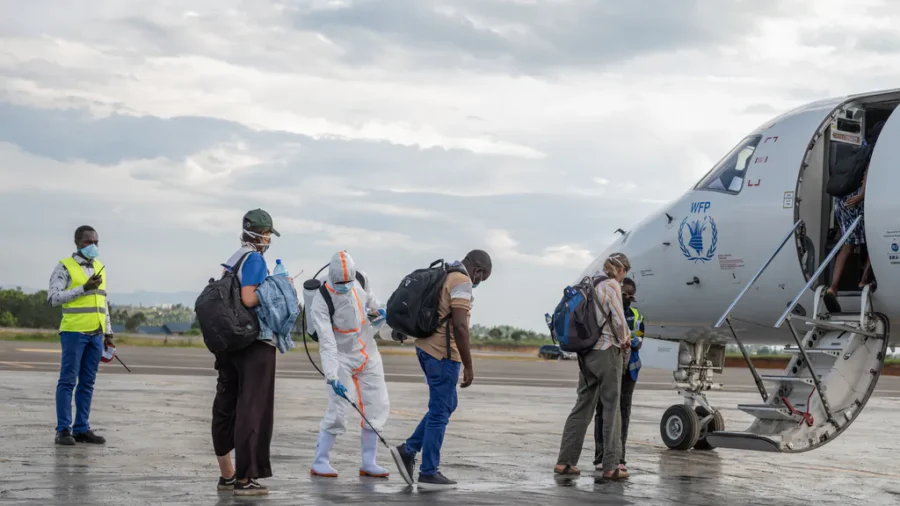
To prevent the virus from entering the United States, the CDC and the Department of Homeland Security announced enhanced travel screening and entry restrictions on May 18.
Travelers arriving by air from the DRC, Uganda, and South Sudan—included due to its shared borders with affected nations—will be rerouted to one of four designated U.S. airports: Washington Dulles, Atlanta Hartsfield-Jackson, Houston George Bush Intercontinental, or New York JFK.
No Ebola cases linked to the current outbreak have been confirmed in the United States, and the overall risk to the American public and travelers remains low, the CDC said.