


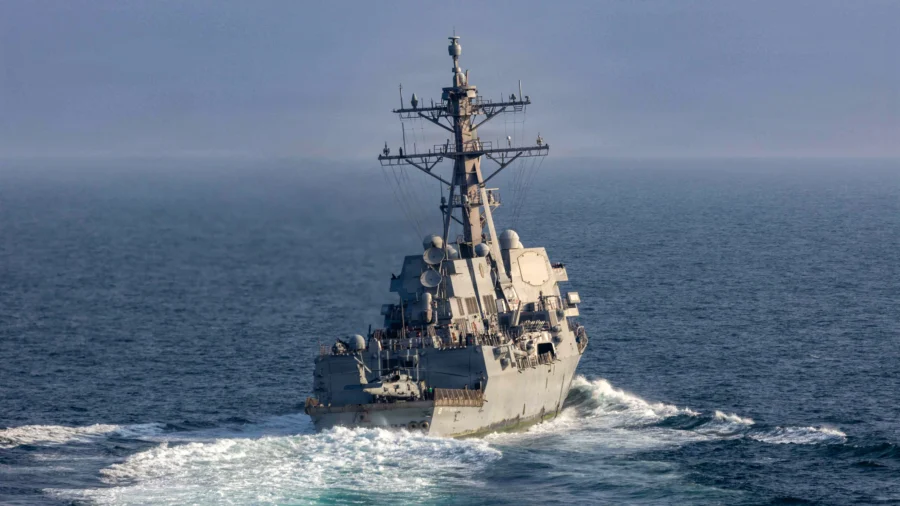
The United States has significantly expanded the scope of its naval blockade on Iran, signaling that vessels linked to Tehran can now be boarded, searched, and seized on the high seas worldwide under wartime enforcement authorities, according to Pentagon leadership and a maritime advisory circulated to commercial shipping.
The update, issued via a Joint Maritime Information Center (JMIC) note on April 16 citing U.S. Naval Forces Central Command, states that “all Iranian vessels, vessels with active OFAC sanctions, and vessels suspected of carrying contraband … are subject to visit, board, search, and seizure,” regardless of location.
Broad Definition of Contraband
According to the advisory, “absolute contraband” includes weapons, ammunition, military vehicles, and specialized systems. But it also designates “conditional contraband” such as petroleum, industrial materials, machinery, electronics, and communications equipment when destined for Iran and deemed supportive of its military or war-sustaining economy.The breadth of the definition suggests the expanded enforcement could affect cargo flows beyond energy shipments, including goods traded by third countries with Iran, if U.S. officials determine they have a potential military end use.
While the blockade remains centered on Iran’s coastline and surrounding waters, the updated guidance invokes the “belligerent right to visit and search,” a doctrine in the law of naval warfare that permits interception of suspected enemy-linked shipping on the high seas.
Chairman of the Joint Chiefs of Staff Gen. Dan Caine confirmed during Thursday’s Pentagon press briefing that the blockade is being applied beyond the immediate Gulf theater, with U.S. forces prepared to pursue vessels tied to Iran across multiple operational areas.
“The joint force, through operations and activities in other areas of responsibility, like the Pacific Area of Responsibility … will pursue any Iranian-flagged vessel or any vessel attempting to provide material support to Iran,” Caine said, adding that enforcement could involve direct action at sea, including boarding and seizure.
Shadow Fleet in Focus, Retaliation Risks
Analysts say the expanded rules, which also take aim at Iran’s so-called shadow fleet—a network of more than 500 tankers used to transport oil and other cargos under sanctions—could draw Iranian retaliation.“Then, the ball is in Iran’s court in terms of retaliation that could include anything from boarding, ship attack, port attack and even expanding to the Red Sea,” Martin Kelly, head of advisory at EOS Risk Group, wrote in a post on X on Thursday.
US Forces ‘Rearming, Retooling’
During Thursday’s briefing, the head of U.S. Central Command, Adm. Brad Cooper, said U.S. forces are using the ceasefire period to prepare for sustained operations across the region if the fighting resumes.“We’re rearming, we’re retooling, and we’re adjusting our tactics, techniques, and procedures. There’s no military in the world that adjusts like we do, and that’s exactly what we’re doing right now during the ceasefire,” Cooper said.
He described U.S. forces operating across more than 70 locations in the Middle East, supported by regional partners and integrating new technologies, including artificial intelligence and drone systems, into operational planning.
“I met with teams who launched our own one-way attack drones into Iran,” Cooper said. “These were originally Iranian-designed drones. We brought them back to America, took the guts out, put a ‘Made-in-America’ stamp on them, and fired them right back to Iran. Very effective.”
Hostilities could resume if the two-week ceasefire announced by U.S. President Donald Trump on April 7 ends without a breakthrough in talks.
“We feel good about the prospects of a deal,” she said.
During Thursday’s briefing, Secretary of War Pete Hegseth urged Iranian leaders to “choose wisely” and take the deal.
“We’d prefer to do it the nice way, through a deal led by our great vice president and negotiating team, or we can do it the hard way,” he said. “We urge this new regime to choose wisely.”