


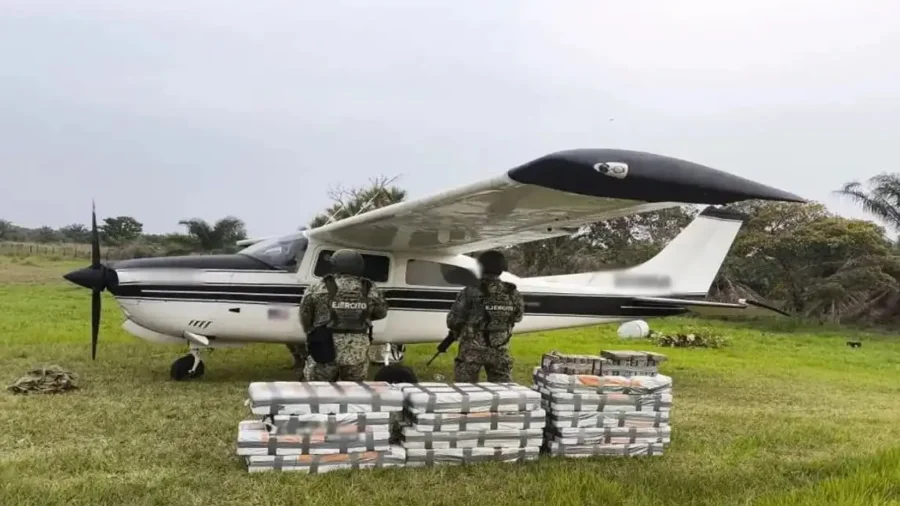
U.S. authorities seized 636 kilograms (approximately 1,402 pounds) of cocaine in a multi-national operation that led to the interdiction of an illicit aircraft transporting the narcotics.
The Joint Interagency Task Force (JIATF) South was one of the agencies involved in the operation. It coordinated with partners from Mexico, Guatemala, Costa Rica, and Panama to intercept the aircraft, the JIATF South said in a May 20 post on X.
Surveillance on the aircraft was maintained across Central America, with Mexican ground forces seizing the narcotics.
Commenting on the operation, the U.S. Southern Command (SOUTHCOM) said in a May 20 post on X, “Partnerships in action to disrupt narco-terrorist networks in the Western Hemisphere.”
Multiple other drug interdictions have been made by U.S. authorities in recent days.
In a May 22 post on X, JIATF South said that it coordinated with SOUTHCOM and Panamanian forces to intercept three vessels in the Eastern Pacific region, which carried 284 pounds of cocaine and 2,016 pounds of marijuana. Nine suspects were detained.
SOUTHCOM said that the Americas Counter Cartel Coalition was disrupting narco-terrorism in the Western Hemisphere, citing Ecuador’s seizure of weapons and explosives from Los Choneros, a U.S.-designated terror outfit linked to narcotics trafficking.
The Americas Counter Cartel Coalition was established by U.S. Secretary of War and includes 17 nations from the Western Hemisphere committed to “operationalize hard power” to counter cartels and transnational gangs in the region, according to a March 7 proclamation issued by President Donald Trump.
In March, the first-ever Americas Counter Cartel Conference was held at SOUTHCOM headquarters in Florida. At the event, Stephen Miller, White House deputy chief of staff, told attendees that simply pursuing a “criminal justice solution” was not enough to combat narco-terrorists.
“These organizations can only be defeated with military power,” Miller said. “The cartels that operate in this hemisphere are the ISIS and the al-Qaeda of the Western Hemisphere and should be treated just as brutally and just as ruthlessly as we treat those organizations.”
“We are not going to cede an inch of territory in this hemisphere to our enemies or adversaries.”
Earlier this month, drug czar Sara Carter released the 2026 National Drug Control Strategy that outlined several key focus areas to combat drug trafficking threats facing the United States.
The strategy aims to stop the flow of illicit drugs into communities, fight against foreign terrorists and transnational criminal organizations while securing the global supply chain against these threats, recognize the power of faith to heal drug addiction, strengthen rescue and overdose response in the country, and define current and emerging drug threats.
“President Trump stemmed the flow of drugs into our country by taking back our borders and executing kinetic strikes against narcoterrorists. The Strategy builds on this success to stop illicit drugs and precursor chemicals from entering the U.S. at every point of entry, whether it be land, sea, air, or mail,” the White House Fact Sheet said.
“The Strategy defends international supply chains from being used as a pipeline to transport finished drugs that are poisoning communities and the precursor chemicals used to make them.”
The drug trafficking and related weapons offenses charges against Mexican officials were announced by the U.S. Department of Justice last month.
“Given that there is an arrest warrant in the United States against 10 people, the banks here—because they have relationships with banks there—take a series of measures,” Sheinbaum said.
“Automatically, preventively, the UIF does it,” she said, referring to the Unidad de Inteligencia Financiera (UIF), Mexico’s financial intelligence unit.