


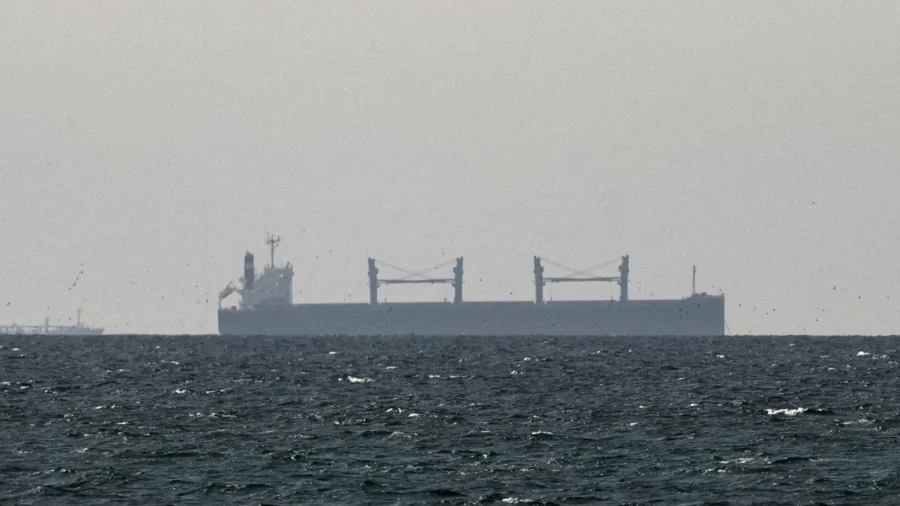
The U.S. Central Command (CENTCOM) said Sunday that the U.S. military will launch its naval blockade of the Strait of Hormuz starting Monday, coming hours after President Donald Trump made the announcement.
A post from CENTCOM said the blockade operation will begin April 13, confirming a “blockade of all maritime traffic entering and exiting Iranian ports.”
“The blockade will be enforced impartially against vessels of all nations entering or departing Iranian ports and coastal areas, including all Iranian ports on the Arabian Gulf and Gulf of Oman,” added CENTCOM, which oversees operations for the Middle East.
The command further said that U.S. military forces won’t interfere with freedom of navigation for vessels traveling in the Strait of Hormuz, a key waterway that normally sees roughly a fifth of the world’s oil traffic pass through it, so long as those ships are visiting non-Iranian ports.
“Additional information will be provided to commercial mariners through a formal notice prior to the start of the blockade,” it said. “All mariners are advised to monitor Notice to Mariners broadcasts and contact U.S. naval forces on bridge-to-bridge channel 16 when operating in the Gulf of Oman and Strait of Hormuz approaches.”
Earlier in the day, Trump announced the blockade in a Truth Social post after weekend negotiations between a U.S. delegation led by Vice President JD Vance and an Iranian delegation fell through.
The strait has effectively been blocked for commercial traffic since the start of U.S.–Israeli strikes on Iran that began on Feb. 28, leading to significant increases to the prices of price of oil and gas while prompting concerns about the world economy.
Trump said on social media that he told the U.S. Navy to “seek and interdict every vessel in International Waters that has paid a toll to Iran. No one who pays an illegal toll will have safe passage on the high seas.” He said other nations would be involved in enforcing the blockade but did not name them.
Iran’s Revolutionary Guard later said the strait remained under Iran’s “full control” and was open for non-military vessels, but military ones would get a “forceful response,” two semi-official Iranian news agencies reported.
During the 21-hour talks, mediated in Pakistan, the U.S. military said two destroyers transited the strait ahead of mine-clearing work, a first since the war began. Iran denied this took place.
The face-to-face talks that ended early Sunday were the highest-level negotiations between the longtime rivals since the 1979 Islamic Revolution. Neither side indicated what will happen after the ceasefire expires on April 22.
“We need to see an affirmative commitment that they will not seek a nuclear weapon,” said Vance following the talks.
Iran’s nuclear program was at the center of tensions long before the United States and Israel launched the strikes, which have killed much of Iran’s top leadership. Tehran has long denied seeking nuclear weapons but insists on its right to a civilian nuclear program.
Israel and the United States have said Iran is pursuing nuclear weapons, while the International Atomic Energy Agency has long said that Tehran’s accumulation of high-grade enriched uranium and denial of access for inspectors to view its nuclear facilities are “serious concerns.”