


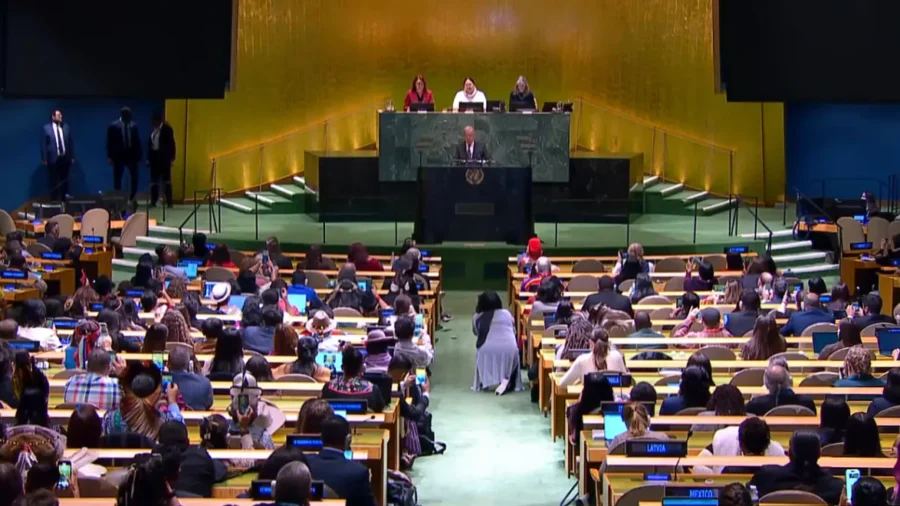
The United States objected strongly after Iran was selected as one of the 34 vice presidents of the United Nations Nonproliferation Treaty conference on April 27.
Iran was a candidate proposed by the Non-Aligned Movement, made up of 121 developing countries, most of which are in Africa and Asia.
The conference, held every five years since 1970, involves all 191 parties to the Nuclear Nonproliferation Treaty (NPT) reviewing its implementation.
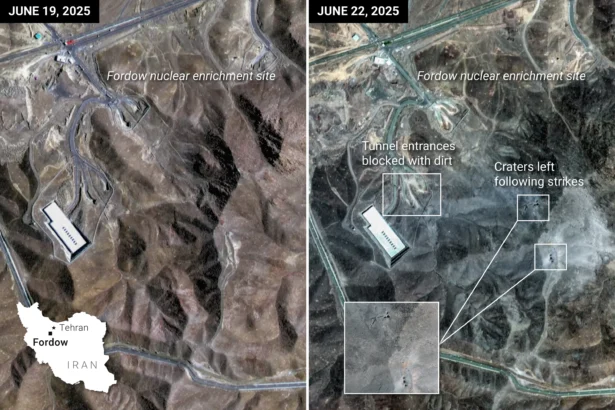
Under the terms of the NPT, Iran is obliged to cooperate with the International Atomic Energy Agency (IAEA), a U.N. agency, but it has not given IAEA inspectors access to nuclear sites since they were bombed by the United States in June 2025.
Christopher Yeaw, U.S. assistant secretary of state for arms control and nonproliferation, said it was "indisputable that Iran has long demonstrated its contempt for the non-proliferation commitments of the NPT."
Australia, UAE Back the US
The U.S. position was supported by Australia and the United Arab Emirates, while the UK, France, and Germany expressed “concern.”The UK, France, and Germany—collectively known as the E3—were signatories to the 2015 Joint Comprehensive Plan of Action (JCPOA), negotiated by the Obama administration, which was designed to curb Iran's nuclear program.
The chair of the conference, the Vietnamese ambassador to the U.N., Do Hung Viet, said the objections and reservations expressed would be duly recorded in the meeting minutes.

The Iranian ambassador to the U.N. in Vienna, Reza Najafi, said Washington's allegations were “baseless and politically motivated,” and declared Iran's opposition to the United States being one of the 34 NPT conference vice presidents.
The documents for the conference, which is due to last until May 22, include a reference to a working paper submitted by Iran, which called for the "establishment of a nuclear-weapon-free zone in the Middle East."
The U.N.'s website states, "The NPT is a landmark international treaty whose objective is to prevent the spread of nuclear weapons and weapons technology, to promote cooperation in the peaceful uses of nuclear energy and to further the goal of achieving nuclear disarmament."
In a statement to the 35-nation board of governors of the International Atomic Energy Agency (IAEA) on June 9, Director General Rafael Grossi said he was seriously concerned about Iran’s “rapid accumulation of highly enriched uranium.”
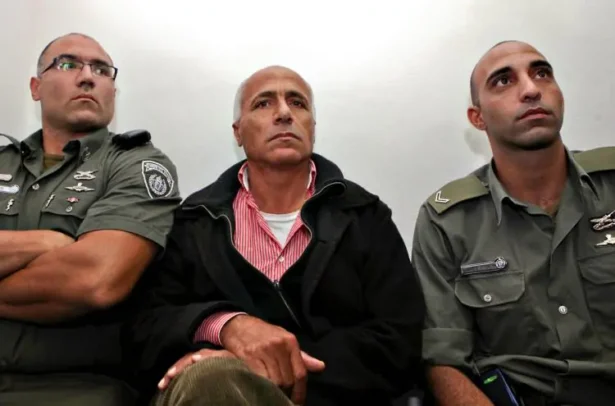
At present, Israel is widely believed to be the only country in the Middle East that possesses nuclear weapons, although it has never confirmed or denied doing so.
The UK's House of Commons Library states, "It is universally acknowledged that Israel has a nuclear weapons capability which it developed outside the framework of the Nuclear Non-Proliferation Treaty (NPT)."
The Stockholm International Peace Research Institute in its World Nuclear Forces profile on the country states that Israel "continues to maintain its long-standing policy of nuclear opacity: it neither officially confirms nor denies that it possesses nuclear weapons."
"It is estimated that Israel has approximately 80 nuclear weapons," the institute states. "Of these, approximately 30 are gravity bombs for delivery by aircraft. The remaining 50 weapons are for delivery by Jericho II medium-range ballistic missiles, which are believed to be based with their mobile launchers in caves at a military base east of Jerusalem."
US Considering Iranian Proposal
On April 27, White House press secretary Karoline Leavitt said Trump had discussions with national security aides after the Iranian regime submitted a new proposal to resolve the conflict.During the NPT conference's opening session on April 27, U.N. Secretary-General António Guterres urged the treaty parties “to stand together and safeguard humanity from the grave threat of nuclear annihilation.”
Under the NPT, the five original nuclear powers—Russia, China, Britain, France and the United States— agreed to negotiate toward eventually eliminating their arsenals, and nations without nuclear weapons promised not to acquire them but can develop nuclear energy for peaceful purposes.
Since the NPT was signed, India, Pakistan, and North Korea have developed nuclear weapons.