


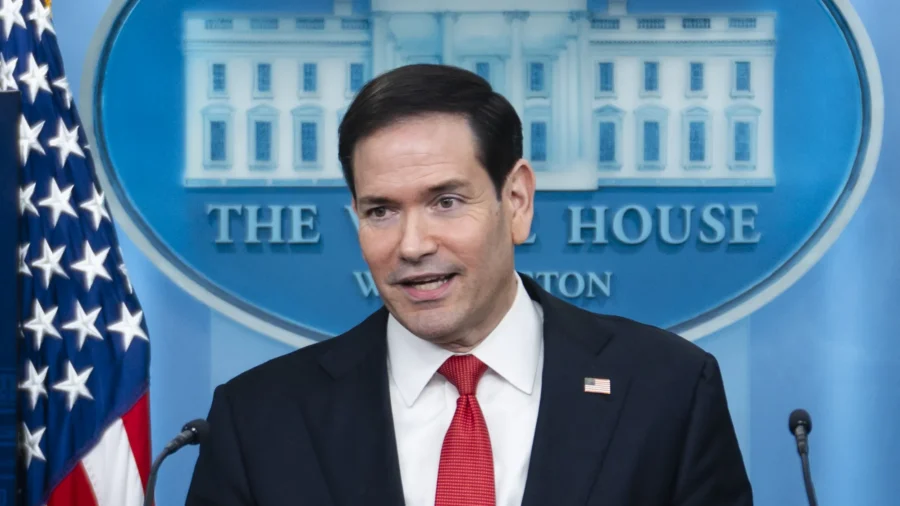
WASHINGTON—U.S. Secretary of State Marco Rubio said on May 5 that China’s human rights violations remain a key concern for the Trump administration and will be on the agenda during the president's upcoming visit to Beijing.
U.S. President Donald Trump will visit Beijing on May 14 and May 15 for meetings with Chinese leader Xi Jinping. Rubio is expected to accompany him.
At a White House news briefing, Rubio confirmed that human rights violations, including forced organ harvesting, remain important priorities for the administration.
“We always raise those issues, and they remain true,” Rubio said in response to a question from NTD, a sister media outlet of The Epoch Times. “I think we’ve proven in some cases it’s most effective to raise them in the appropriate setting. But we always raise those issues. They’re important to us, among others, of course, but those issues remain prominent in our view and in our conversation about these things, and we’ll continue to raise them in the appropriate forums.”
Reintroduced in March by Sens. Ted Cruz (R-Texas) and Jeff Merkley (D-Ore.) under the name Falun Gong and Victims of Forced Organ Harvesting Protection Act, the bill seeks to impose sanctions on those complicit in the abuse.
Taiwan remains another major sticking point between Washington and Beijing.
Rubio said at the news briefing that both sides recognize their respective positions and seek to avoid instability in the Taiwan Strait.
“I'm sure Taiwan will be a topic of conversation," he said. "It always is. We don’t need any destabilizing events to occur with regard to Taiwan or anywhere in the Indo-Pacific, and I think that’s to the mutual benefit of both the United States and the Chinese.”
U.S. pressure on Beijing is expected to increase ahead of Trump’s visit. During the briefing, Rubio told The Epoch Times that the United States is considering options if Beijing chooses to ignore U.S. sanctions on Iranian oil.
China has recently moved to counter U.S. sanctions using its anti-sanctions law. Beijing has instructed Chinese companies to ignore U.S. sanctions placed on five Chinese refiners processing Iranian crude oil.
“If you ignore our sanctions, you’re going to face secondary sanctions,” Rubio said, referring to the Treasury Department’s announcement regarding potential new sanctions.
“We don’t do these things for symbolic purposes."
The U.S. State Department also confirmed that Washington is preparing to impose travel restrictions on China if Beijing slows its efforts to repatriate Chinese nationals who are in the United States illegally. The plan was first reported by Reuters.
For years, China has resisted U.S. requests to repatriate tens of thousands of its citizens who have overstayed visas or entered the United States illegally.
During the news briefing, Rubio commented on Iranian Foreign Minister Abbas Araghchi’s visit to Beijing on May 5. He stated that China should increase pressure on Iran to keep the Strait of Hormuz open. Rubio expressed hope that Beijing would urge Iran to avoid attacking ships, placing mines in the strait, or disrupting the global economy.
“It’s obvious China is an export-driven economy," Rubio said. "That means they depend on other countries to buy from them. Well, you can’t buy from them if you can’t ship it there, and you can’t buy from them if your economy is being destroyed by what Iran is doing. It is in China’s interest that Iran stopped closing the straits.”