


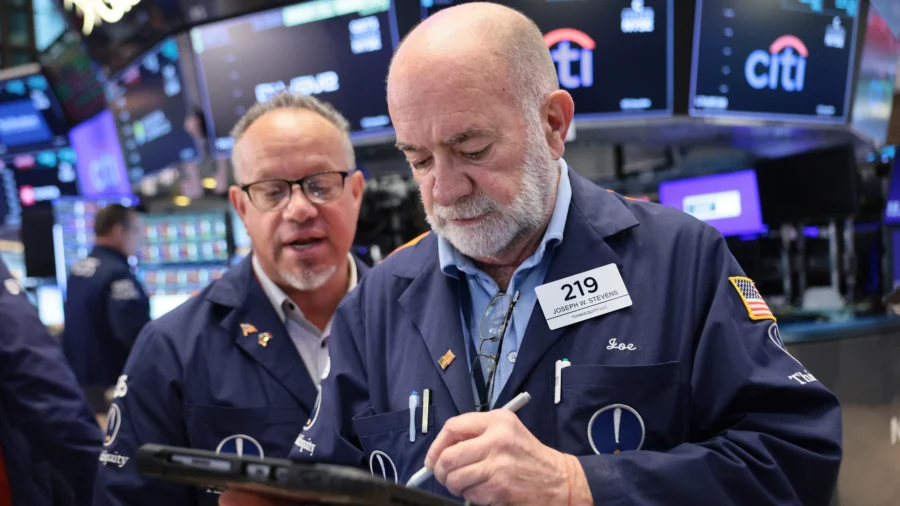
The S&P 500 rallied for the eighth week, while the Dow Jones Industrial Average closed at another record high despite elevated bond yields and signs of an economic slowdown.
Trade was volatile, as bond yields fluctuated widely during the week, following swings in oil prices and the release of the Federal Open Market Committee meeting minutes, which suggested an interest rate hike may be in the offing. Some analysts are concerned about valuations, especially in the hot tech sector.
For the week, the Dow Jones Industrial Average rose by 2.13 percent to close at 50,579, near its weekly high reached on May 22. The S&P 500 edged up by 0.88 percent to 7,473. The Nasdaq Composite finished up by 0.45 percent, while the Russell 2000 fared the best, up by 2.72 percent.
The Chicago Board Options Exchange Volatility Index closed the week at 16.70, down by 9.39 percent.
Stocks opened mostly lower on May 18, carrying over the negative sentiment from May 15, which had pulled major indexes back from record highs.
A surge in oil prices and elevated bond yields added to the negative sentiment for equities. West Texas Intermediate crude oil futures edged up toward $107 per barrel amid growing uncertainty over the prospect of reopening the key Strait of Hormuz.
The yield on the benchmark U.S. 10-year Treasury note hovered around 4.6 percent, as traders hesitated to make major bets on market direction amid persistent geopolitical turbulence and a lack of clarity on monetary policy, following a couple of hot inflation readings released the previous week.
Trading was choppy, with major equity averages ending mixed. The Nasdaq and the S&P 500 ended 0.5 percent and 0.1 percent lower, respectively, while the Dow ended 0.3 percent higher.
As was the case on May 15, one of the factors that spared equity markets from a more severe, broader sell-off was a rotation out of market leaders, such as tech hardware, and into laggards, such as software.
“The stock market is coming to the sudden realization that new Fed Chair Kevin Warsh may need to raise rates rather than lower them, and the market hates that,” said Richard Reyle, chief investment officer of Paramus, New Jersey-based Questar Capital Partners.
He said the bond market was repricing this in, and yields were trending higher, “which comes just as the hyperscalers enter their most capital-intensive spending cycle, which raises worries about their ability to keep funding this spending.”
Reyle thinks the swift rise in bond yields could threaten the tech sector's leadership in the stock market, especially at a time when valuations have grown stretched.
Stocks came under renewed pressure on May 19 amid another spike in oil prices and bond yields, with the 30-year Treasury bond hitting 5.18 percent, its highest level since 2007.
Small caps, which are the most sensitive to rising yields, suffered the biggest losses, with the Russell 2000 dropping by 0.96 percent. The Nasdaq, S&P 500, and the Dow decreased by 0.84 percent, 0.67 percent, and 0.65 percent, respectively.
The losses across all indexes came despite bargain hunters returning in early afternoon to scoop up semiconductor shares following a three-day sell-off.
Trading on May 20 began with investor attention fixed on Nvidia's earnings, scheduled to be released after the market closed.
“Nvidia's earnings will help set the tone for a stock market that is in need of its next catalyst after an incredible run since the March lows,” Paul Stanley, chief investment officer of Portsmouth, New Hampshire-based Granite Bay Wealth Management, told The Epoch Times.
He said the market needed a new catalyst, noting that investors have become somewhat tired after recent gains and are increasingly focused on renewed concerns about higher bond yields and the risk of Federal Reserve interest rate hikes amid a resurgence of inflation.
Those worries eased in early trading amid a sharp pullback in oil prices on renewed hopes of the reopening of the Strait of Hormuz, which pressured bond yields and helped equities stage a strong rebound.
The Russell 2000 and Nasdaq led the way, up by 2.32 percent and 1.6 percent, respectively. The Dow Jones and the S&P 500 followed closely behind, with gains of 1.3 percent and 1.1 percent, respectively.
Nvidia’s earnings results, released in the afternoon, set the tone for early trading on May 21.
The semiconductor leader beat on both the top and bottom lines and issued upbeat guidance, but that was not enough to satisfy the bullish tech crowd on Wall Street. The stock closed 1.77 percent lower, dragging the rest of the semiconductor sector down.
“Nvidia's revenue growth was monstrous and the company continues to enjoy the golden era of its business model,” David Bahnsen, chief investment officer of The Bahnsen Group, told The Epoch Times.
“But the biggest risk to investors is that almost every good thing with Nvidia is virtually universally known and therefore priced in, and every bad thing, such as less spending from the hyperscalers, is not at all priced in.”
Trade in the broader market was choppy, with major equity indexes fluctuating between gains and losses amid wild swings in oil prices.
West Texas Intermediate crude futures slid more than 2 percent in the afternoon trading after rising as much as 3 percent earlier in the session, amid growing optimism that the conflict involving Iran could ease.
Retail stocks were hard hit following lackluster earnings reports from Target on May 20 and Walmart on May 21. Quantum computing stocks gained following news that the U.S. government is investing $2 billion in the sector.
All major equity averages finished the May 21 trading in the green, led by the Russell 2000, up by 0.93 percent, followed by the Dow, up by 0.55 percent. The S&P 500 and Nasdaq posted slight gains of 0.17 percent and 0.07 percent, respectively.
Trade remained choppy on May 21 amid persistent volatility in the oil market and a weak economic report.
All major equity averages nonetheless closed higher, led by the Russell 2000, up by 0.72 percent, followed by the Dow Jones, up by 0.58 percent. The S&P 500 and Nasdaq closed up by 0.37 percent and 0.19 percent, respectively.
Bret Kenwell, a U.S. investment analyst at eToro, told The Epoch Times that the strong rally in tech stocks has raised concerns that the sector is overbought, and investors are watching for a possible pullback or consolidation, though rotation within the sector could help ease stretched conditions.
Bahnsen is concerned about an overheated market and stretched valuations.
“While this vertical move higher in stocks can last for some time, there will eventually be a reversal, and those with too much tech and semiconductor exposure will face a reckoning,” he said.