


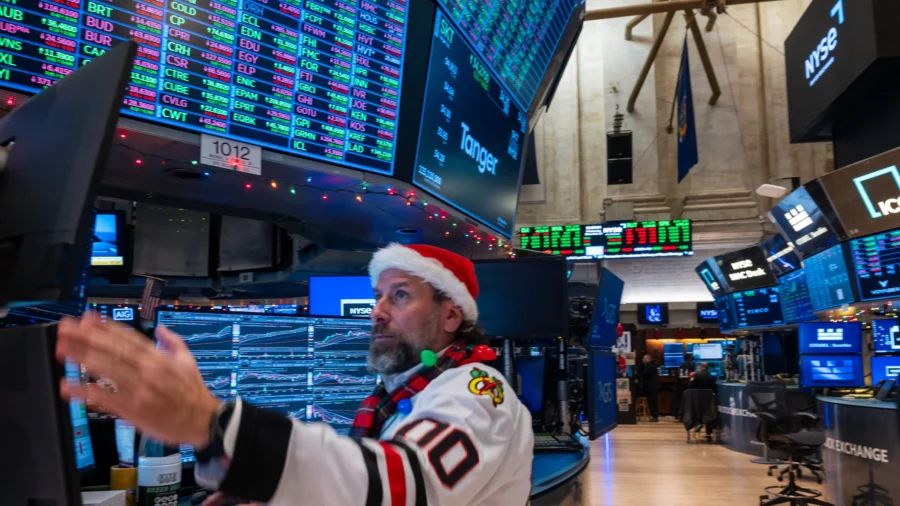
U.S. equities reached new records this week, supported by solid economic data, the Santa Claus rally, and light trading volume, which further fueled the market’s gains.
The Dow Jones Industrial Average rose by 1.58 percent for the week to 48,710, holding slightly below the week’s record high reached on Dec. 24. The S&P 500 gained by 2.29 percent to 6,929, also just below its new record high on Dec. 24. The tech-heavy Nasdaq Composite fared the best, rising by 2.55 percent to a new record, while the small-cap Russell 2000 ended 1.06 percent higher.
Market volatility declined for another week, with the Chicago Board Options Exchange Volatility Index falling by 8.79 percent to 13.6.
Equity market bulls raced out of the gate on Dec. 22, encouraged by solid gains in the last two trading sessions of last week, following better-than-expected inflation data released on Dec. 18.
Aiding the positive sentiment were the holiday spirit and the expectation of a Santa Claus rally—a period when equities usually rise during the final five trading days of December and the first two trading days of the new year.
The bulls maintained the upper hand throughout the trading session, closing decisively in the green, with small caps gaining more than 1 percent.
“As we enter a shortened trading week and the final few trading sessions of the year, stocks are trying to stabilize from this month’s volatility and make it to new all-time highs,” Clark Bellin, president and chief investment officer at Nebraska-based Bellwether Wealth, told The Epoch Times.
“Even though the market may feel turbulent in recent weeks, stocks have largely stayed range-bound so far in December, and the year-end seasonal strength may just be the catalyst we need for the market to break out of its narrow trading range,” he said.
The seasonal strength in equities continued on Dec. 23, with the Nasdaq, the Dow, and the S&P 500 posting solid gains. At the same time, the Russell 2000 lost some ground on profit-taking after outperforming the broader market on the previous day.
The third-quarter GDP growth reading is the highest in two years, reflecting increases in consumer spending, exports, and government spending.
Consumer spending, which accounts for close to two-thirds of GDP, was robust despite several surveys showing depressed consumer sentiment. It was up by 3.5 percent in the third quarter, the most so far this year, compared with 2.5 percent in the second quarter, led by both goods and services, mostly health care, international travel, information processing equipment, and prescription drugs.
Another catalyst for the day’s gains was low volume, which amplified the positive economic news’ impact on equity prices.
“The stock market is finally starting to eke out some gains for December after a choppy few weeks, and just in time for the market’s Santa Claus rally, which we expect to take place in its typical format via the last several trading days of the year,” Paul Stanley, chief investment officer at New Hampshire-based Granite Bay Wealth Management, told The Epoch Times.
“The combination of low volume and an absence of bad news should keep the Santa Claus rally alive and well for the rest of 2025.”
The Santa Claus rally remained alive on the shortened trading session on Dec. 24, with all major equity averages closing in the green, with the S&P 500 reaching another record.
Aiding the bullish investor sentiment in the trading session was another positive report on the economy.
A lower reading indicates that layoffs are tapering off, suggesting that the labor market is improving.
The S&P 500 and Nasdaq continued to rise on Dec. 26 as investors returned from the Christmas holiday, with the S&P 500 setting a new record in early trading. However, all major averages closed slightly lower on year-end profit-taking.
Stanley still favors techs, which he believes have a staying power and leadership in this market, especially for 2026.
“Valuations in tech are high, but some Mag 7 names have underperformed the S&P 500 this year, which suggests that there is still more room to run and that not all tech stocks are trading at runaway or complacent valuations,” he said.
“The big uncertainty for 2026 is who the next Federal Reserve chair will be. While the next chair is likely to be dovish, Fed chair transitions come with volatility as it can take some time for investors to get used to the new chair’s communication style,” Stanley concluded.