


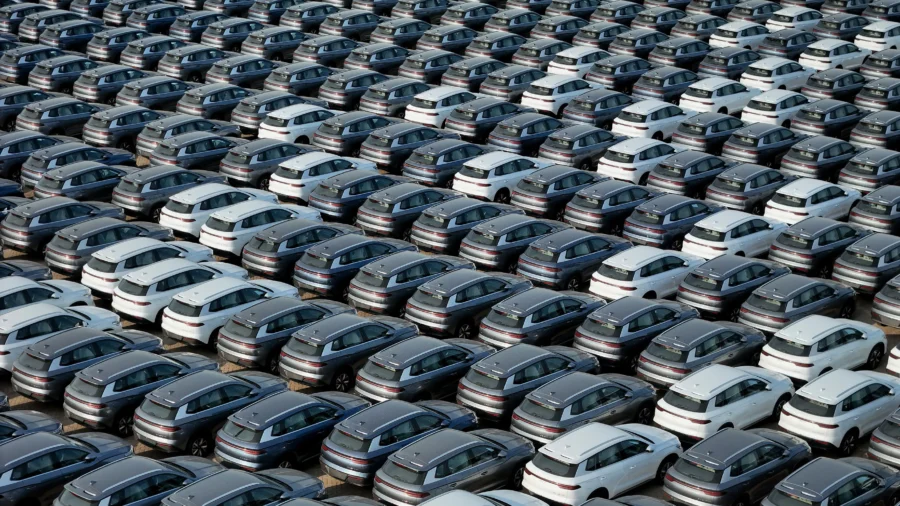
The Chinese regime is urging a stop to the practice of selling brand-new cars as heavily discounted used vehicles to reduce inventory.
The country's automotive industry has experienced increased competition in recent years, with automakers significantly cutting prices and the emergence of the "zero-mileage second-hand car" phenomenon in the car market.
"Zero-mileage second-hand cars" refer to brand-new vehicles labeled as second-hand that have completed registration but have extremely low or zero mileage.
"This disguised form of price cutting disrupts normal market order and is a striking example of the auto industry's 'involution,'" the People's Daily said, using a term widely used in China to describe intense and cutthroat competition.
"Once market competition rules are properly enforced, 'zero-mileage used cars' won't be able to run far—or for long," the People's Daily continued.
It added that this practice is detrimental to both manufacturers and consumers.
In the short term, this tactic may help reduce inventory, “but [it] compresses profit margins, increases losses, and hinders investment in product quality and innovation—ultimately harming sustainable development,” the article said. For consumers, these seemingly discounted vehicles carry risks such as “the loss of first-owner benefits, potential battery degradation, and steeper depreciation when reselling.”
On May 27, China's Ministry of Commerce held a meeting with industry associations and carmakers, such as BYD and Dongfeng Motor, to address the growing issue of "used cars" with zero mileage.
Why sell brand-new cars as second-hand? Wei explained that some automakers, in pursuit of sales figures and stock market performance, deliberately create an illusion of high demand through "zero-mileage second-hand cars" to conceal their actual inventory backlog and financial pressures.
Automotive Price War
As U.S. tariffs exacerbate the gloomy sentiment in the world's second-largest economy, China is facing increasing deflationary pressures. A price war is sweeping through the Chinese automotive industry, with many car companies struggling to meet sales targets.In addition to the phenomenon of "zero-mileage second-hand cars," another trend is placing significant price cuts on new vehicles.
The "618 Mid-Year Promotion" is a major shopping promotional event held by Chinese e-commerce platforms around June 18 each year, a nationwide online shopping frenzy in China, similar to Black Friday in the United States.
This is already BYD’s third wave of price-cut promotions this year. The scope has expanded from 10 non-intelligent driving models to 22 intelligent driving models, with increasingly aggressive discounts to boost sales figures.
Frank Tian Xie, a professor of business at the University of South Carolina Aiken, told The Epoch Times that the phenomenon of China’s electric vehicle industry resembles a “Great Leap Forward,” resulting in brutal competition.
The Great Leap Forward was a radical economic and social campaign initiated by the CCP under Mao Zedong from 1958 to 1962.
Xie said: “China’s electric vehicle industry saw a rush of over 200 EV factories, without fully addressing issues related to technology, safety, and quality. They rushed into production, eager to capitalize on the CCP government subsidies. The result of this ‘Great Leap Forward’ approach is inevitably intense, extremely fierce, and, in reality, very brutal competition.”
Sun Guoxiang, an associate professor at the University of Nanhua in Taiwan, told The Epoch Times that the “involution” in China’s auto industry stems primarily from the CCP's subsidy policies and industry guidance for new energy vehicles in recent years.
This has led to overcapacity and market saturation in the automotive sector, resulting in “a flood of companies entering the market, causing oversupply and increasingly fierce competition,” he said.
Sun believes that the practice of “zero-mileage second-hand cars” is a “financial tactic to falsify performance and embellish inventory reports” and carries significant risks.