


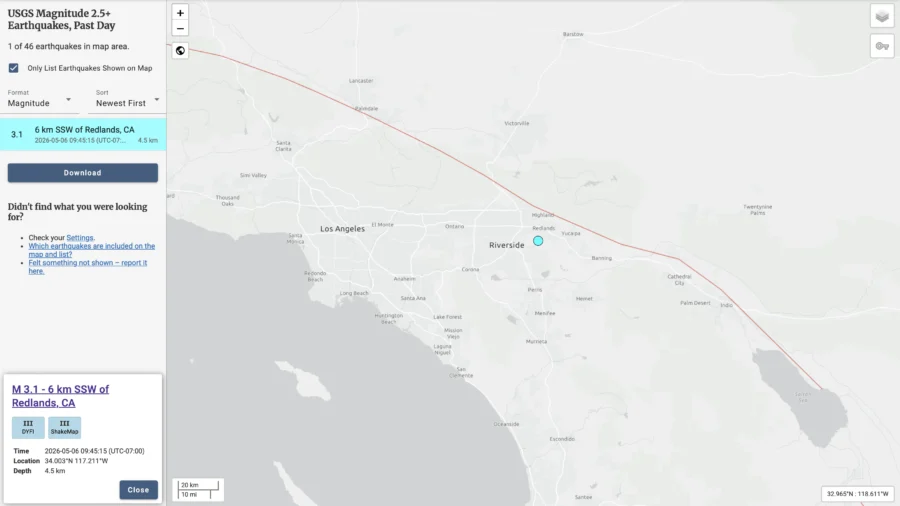
A pair of earthquakes struck southwest of Redlands early Wednesday morning, rattling residents across a wide stretch of the Inland Empire. There were no reports of injury or major damage.
The USGS Community Internet Intensity Map classified the shaking as "light," and the quakes were felt across a wide swath of Southern California that included Riverside, Rancho Cucamonga, Yucaipa, Perris, and Corona.
More Seismic Activity
Wednesday's quakes come as seismic activity in Southern California has kept residents on their toes in recent months. In January, a magnitude 4.9 earthquake struck approximately 12 miles northeast of Indio, sending tremors through the Coachella Valley around 5:56 p.m. That quake—shallow at just 1.8 miles deep—was followed by aftershocks of magnitude 3.4 and 3.3.The broader Southern California region sits atop one of the most seismically active fault networks in the country. Tectonic motion—specifically the northward movement of the Pacific plate against the North American plate—drives the region's persistent earthquake activity. The San Andreas Fault, stretching 1,200 kilometers from the Salton Sea north to offshore Cape Mendocino, forms the main plate boundary and passes near Indio. Other active fault systems in the region include the San Jacinto, Elsinore, Newport-Inglewood and Rose Canyon Faults, all of which are capable of producing major earthquakes, and the Eastern California Shear Zone, which has been responsible for nearly all significant Southern California earthquakes in recent decades.
The region's seismic history carries sobering reminders of what larger faults can do. The 1857 Fort Tejon earthquake measured magnitude 7.9, killing two people and leaving a 220-mile surface rupture across the landscaped. The 1994 Northridge earthquake, a magnitude 6.7 event, killed 57 people, injured 9,000 more, and caused up to $40 billion in damage.
The Department of Homeland Security's Ready.gov initiative recommends securing heavy household items, building family communication plans, and maintaining emergency supply kits stocked with food, water, flashlights, and first-aid materials. During a quake, the standard guidance is to drop to hands and knees, shelter under sturdy furniture, and protect the head and neck. After shaking stops, residents should remain alert for aftershocks.