


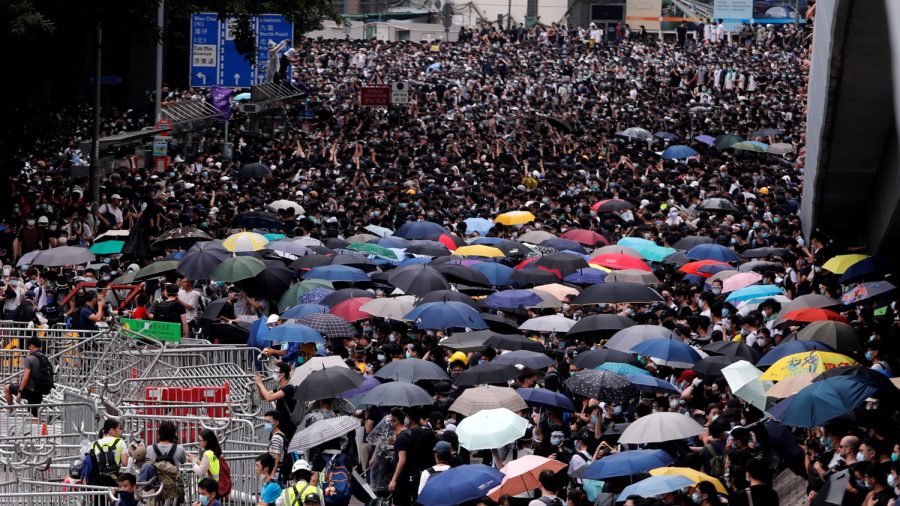
A planned debate among lawmakers on Hong Kong’s controversial extradition bill was abruptly canceled after protesters swarmed the government building where the Legislative Council (LegCo) was set to convene.
The bill, first proposed in February, would allow mainland China to seek the extradition of suspects wanted by the Chinese regime. A broad opposition has since emerged, concerned that the bill could allow the Chinese Communist Party to charge and extradite with impunity.
Local police used pepper spray, tear gas, rubber bullets, and bean bags in an attempt to remove protestors from the streets.
The LegCo was originally scheduled to begin debating at 11 a.m. on June 12.
Tens of thousands of protestors who had gathered outside of LegCo welcomed Leung’s decision with a roar of approval.
The cancelation meant that a scheduled question and answer session with Hong Kong’s top leader, Chief Executive Carrie Lam inside LegCo was also shelved.
Protests
Chants of “now we are back,” “no China extradition, no evil law,” and “scrap it” could be heard among protestors, most of them young people wearing black, throughout the streets near LegCo and the Hong Kong government headquarters on June 12.“Now we are back” was a reference to the Umbrella Movement in 2014, when protesters calling for universal suffrage camped out on the streets of Hong Kong’s main business district in Central for about 3 months. The movement ended without protesters’ demands being met, while several of its main organizers have since been jailed.
The protest to surround the LegCo building was called by the Civil Human Rights Front (CHRF), who also organized the June 9 march that drew 1.03 million to the streets in protest of the extradition bill.
By around 3 p.m. local time, local police outside the government headquarters began using pepper spray against protestors who tried to cross the police line. Some protesters tried to throw objects at the police. According to onsite reporters from the Hong Kong bureau of The Epoch Times, Lam Cheuk-ting, a Democratic Party politician who was at the scene, was also hit with police spray.
At 10 minutes before 4 p.m. local time, local police began using tear gas to disperse protestors gathered at Tim Wa Avenue and the west side of the government headquarters.
Hong Kong media reported that at least 22 protesters have been injured and taken to the hospital.
Bao Tong, former secretary of the late reformist Chinese Communist Party official Zhao Ziyang, in an interview with the Hong Kong bureau of the Epoch Times, condemned the police for firing bean bags.
“Governments firing at their own people—Beijing is capable of doing that and now the Hong Kong government. This isn’t ‘one country, two systems.’ This is ‘one country, one system.’ The system of June 4 [Tiananmen Square Massacre] is that a government can fire at its people,” Bao said.
Opposition
The pressure is mounting against Lam to scrap the extradition bill from inside and outside of Hong Kong.Two Hong Kong college students told the Hong Kong bureau of The Epoch Times’ sister media NTD about why they took part in the protest on June 12.
Li, a student from the University of Hong Kong, said that the extradition bill “directly dealt a blow to Hong Kong’s core value.” He added that if the bill passes, “Hong Kong wouldn’t be Hong Kong anymore, but one of the municipalities of mainland China.”
“After recent years, it is obvious that the Hong Kong government is a pawn of the Chinese Communist Party. After the Umbrella Movement, the government here hasn’t made any changes,” said Chan, another University of Hong Kong student.
On June 11, U.S. House Speaker Nancy Pelosi joined several other lawmakers to publicly expressed concerns about the bill's threat to Hong Kong’s autonomy.
She added: “The extradition bill imperils the strong U.S.-Hong Kong relationship that has flourished for two decades.
“If it passes, the Congress has no choice but to reassess whether Hong Kong is ‘sufficiently autonomous’ under the ‘one country, two systems’ framework.”
Journalism
Local police in Hong Kong has also been accused of interfering with news reporting in the early hours of June 10 when protesters clashed with police officers outside of the LegCo buliding.The statement said that reporters and journalists from various media were “unreasonably removed from the scene by police” on June 10, while some journalists were insulted when police officers called them “trash.”
HKJA said it has demanded a meeting with Hong Kong police chief Steven Lo.
“The proposed changes will put at risk anyone in the territory of Hong Kong who has carried out work related to the Mainland, including human rights defenders, journalists, NGO workers, and social workers, even if the person was outside the Mainland when the ostensible crime was committed,” the letter stated.