


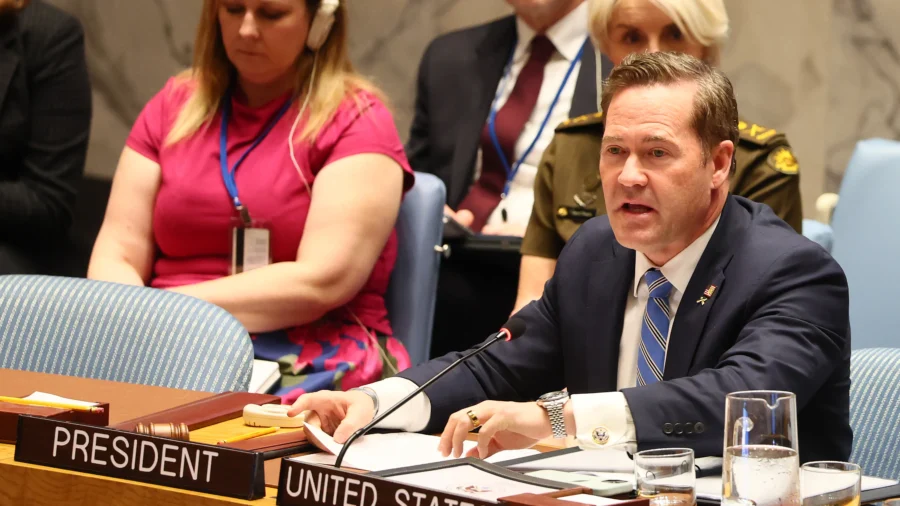
U.S. Ambassador to the United Nations Mike Waltz said Sunday that the United States will push the United Nations Security Council to pass a resolution condemning Iran’s attacks on shipping in the Strait of Hormuz.
“No country can do what Iran is doing in international waterways,” Waltz told ABC’s “This Week.”
“We cannot have a conflict between two countries, whether it’s over a border, resources, a nuclear program, where one side responds by holding the entire world’s economies hostage, by throwing sea mines out in international waterways. Can you imagine if a country did that in the Strait of Gibraltar or the [Strait] of Malacca?”
The U.N. Security Council consists of five permanent members—the United States, Russia, China, France, and the United Kingdom. Ten rotating members are also part of the body.
Since the start of the U.S.–Iran conflict, Tehran has responded by attacking commercial ships in the strait, which connects the Persian Gulf with the broader ocean. The United States over the past month has imposed a blockade on Iranian ports.
The war in Iran has caused the price of oil and gasoline to surge worldwide, with the price for a barrel of Brent crude reaching $101 in the most recent trading period. Meanwhile, West Texas Intermediate crude finished the week at around $95. Data provided by the American Automobile Association has shown that the average price for a gallon of gasoline dropped slightly to $4.52.
Meanwhile the United Arab Emirates’ Defense Ministry said on May 10 it shot down two Iranian drones. And in Kuwait, Defense Ministry spokesperson Brig. Gen. Saud Abdulaziz Al Otaibi said hostile drones entered Kuwait’s airspace that same day and forces responded “in accordance with established procedures.”
Also, Qatar’s Defense Ministry said that a drone on May 10 targeted a commercial ship coming from Abu Dhabi, setting a small fire that was extinguished. The United Kingdom Maritime Trade Operations Center said the attack happened 23 nautical miles northeast of the capital, Doha. It gave no details about the ship’s owner or origin, and there was no claim of responsibility.
On Sunday Iran said it had responded to the latest U.S. ceasefire proposal via Pakistani mediators and wants negotiations to focus on permanently ending the war, according to Iranian state-run media.
The White House has not publicly responded to Iran’s reply and it did not immediately respond to a request for comment.
Waltz told ABC that President Donald Trump is giving diplomacy “every chance we possibly can before going back to hostilities.”
The Iranian regime’s leader, Mojtaba Khamenei, said in a statement released by the semi-official Islamic Republic News Agency that he issued new directives to the country’s military. No details were provided by the directive in the IRNA report, and Khamenei has not been seen in public since he was named as the country’s leader in March.
Israeli Prime Minister Benjamin Netanyahu, in an excerpt of an interview with CBS scheduled to air later Sunday, said the war isn’t over because the enriched uranium needs to be taken out of Iran.
“Trump has said to me, ‘I want to go in there,’ and I think it can be done physically,” Netanyahu said.