


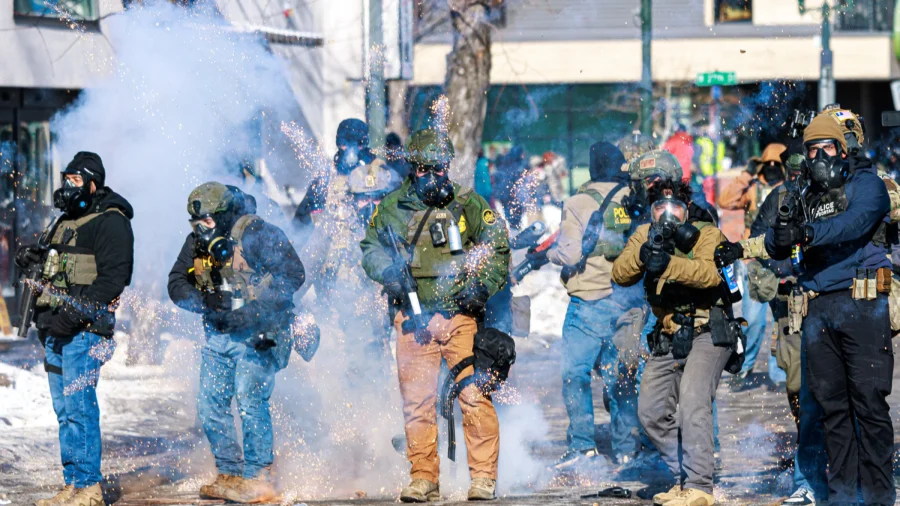
A federal judge heard arguments on Jan. 26 from the state of Minnesota calling for an emergency block of the Trump administration's deployment of thousands of federal immigration agents to the Twin Cities over the past two months.
The plaintiffs claim that the federal government's immigration agent buildup, Operation Metro Surge, breaches Minnesota's state sovereignty and violates the 10th Amendment, which grants authority to the states that the Constitution does not explicitly delegate to the federal government.
"I think that this weekend demonstrated, in a terrifying way, that the current situation is absolutely untenable," attorney Sara Lathrop said, referring to the shooting of a U.S. citizen by a Border Patrol agent on Jan. 24.
"We do not deny that these are serious questions. These are difficult questions, but the relief that we need needs to be now, in order to take down the temperature and allow those important questions to be answered."
Justice Department attorneys defended Operation Metro Surge and argued that the Trump administration is trying to enforce federal immigration laws in Minnesota, citing the state's so-called sanctuary policies that federal officials argue shield illegal immigrants from detention and deportation.
Judge Katherine Menendez of the U.S. District Court for the District of Minnesota analyzed both arguments in a hearing on the morning of Jan. 26 and questioned the district court's authority over separation of powers questions—namely, between the state and federal governments.
"One of the things I'm struggling with is that not all crises have a fix from a district court injunction, and there are other things that are supposed to rein in this kind of conduct," she said from the bench.
"All branches of the federal government are supposed to honor separation of powers between themselves and federalist interests of the state.
"It must be that work is being done elsewhere to try to bring an end to what's described here, not just counting on a single district court issuing a single injunction, which would inevitably and very quickly go to the Eighth [U.S. Circuit Court of Appeals], regardless of whether I write [temporary restraining order] on the top or preliminary injunction."
Menendez suggested that if she were to grant a preliminary injunction, it would still be appealable "regardless of whether other injunctive relief is still underway."
Plaintiffs’ Request to End Surge
Brian Carter, an attorney representing the city of Minneapolis, told Menendez that the plaintiffs were requesting that the court end the federal government’s Operation Metro Surge and return the city to the “status quo” of federal law enforcement before the launch of the operation.He argued that the Trump administration is using the deployment of thousands of federal agents in Minnesota to coerce the state to end its sanctuary policies, which he said violates the 10th Amendment’s “anti-commandeering doctrine.”
That aspect of the 10th Amendment blocks the federal government from forcing state legislatures to pass laws or requiring state officials to administer a federal regulatory program.
“What we’re asking the court to do is to apply the 10th Amendment to prohibit the federal government from coercing the state into legislating or using its resources to affect a federal regulatory scheme,” Carter said.
He cited a letter that Attorney General Pam Bondi sent to Minnesota Gov. Tim Walz on Jan. 24.
In her letter, Bondi said Minnesota has "refused to enforce the law" and demanded that Walz “restore the rule of law, support [Immigration and Customs Enforcement] officers, and bring an end to the chaos in Minnesota,” as well as share state data on Medicaid and food stamps programs, repeal state sanctuary policies, and hand over state voter rolls to the Justice Department.
Plaintiffs argue that this amounts to the federal government trying to coerce Minnesota into altering laws that would be protected by the 10th Amendment, while the Justice Department asserts that the state’s laws violate federal immigration statutes.
The judge asked the Justice Department: If Minnesota immediately acquiesced to the Trump administration’s demands, would that be enough to end the surge of federal agents?
“I can’t commit to any particularities ... but it would change the reaction if they achieved the goal of changing the policy,” said Justice Department attorney Brantley Mayers.
Menendez asked Mayers whether Bondi explicitly wrote in her letter that if Minnesota complied with her demands, the federal government would end the surge, and whether that would amount to forcing the state and Twin Cities to change its laws, a potential violation of the 10th Amendment.
Mayers denied that the letter implies coercion and suggested that it merely states that because of Minnesota’s policies, “there’s a greater law enforcement need in [the] area.”
However, Menendez appeared skeptical of the government’s arguments and said Minnesota was not trying to challenge U.S. immigration law “writ large” with its request for a preliminary injunction, but rather trying to address a single law enforcement initiative: the surge of federal agents to the Twin Cities.
She asked the Justice Department to provide her with an exact count of the federal agents currently deployed to Minnesota.