


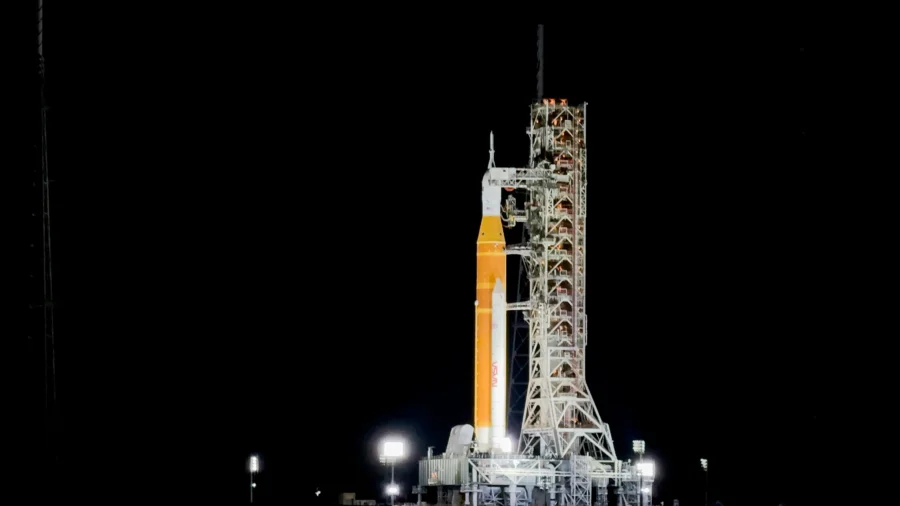
NASA’s hopes of sending astronauts around the moon as early as March 6 appear to have ended just as they began.
The space agency completed what it described as a successful wet dress rehearsal from Feb. 17–19. The four astronauts had been in pre-launch quarantine for less than a day.
In the pre-dawn hours of Feb. 21, officials detected an interruption in helium flow into the rocket’s upper stage.
As a result, the agency announced it may remove the Space Launch System moon rocket and the Orion crew spacecraft from the launch pad. The rocket and spacecraft could be rolled back to the Vehicle Assembly Building (VAB) for further inspection.
“Teams are actively reviewing data and taking steps to enable rollback positions for NASA to address the issues as soon as possible while engineers determine the best path forward.”
The additional pad access platforms installed on Feb. 20 were being removed.
“Regardless of the potential fault, accessing and remediating any of these issues can only be performed in the VAB,” he said.
“As mentioned previously, we will begin preparations for rollback, and this will take the March launch window out of consideration.”
Isaacman said this system worked correctly for both wet dress rehearsals and that a similar problem was observed on Artemis I in 2022.
He explained that the helium bottles on the upper stage are used to purge the engines and pressurize the fuel tanks, but the team was unable to get helium to flow through the vehicle.
NASA said that teams are reviewing potential causes of the issue and reviewing data collected during Artemis I, and are using a ground-based backup system to keep the rocket’s upper stage in a safe configuration.
While some problems, such as the faulty hydrogen fuel line seals, could be resolved without taking the moon rocket off Launch Complex 39B at Florida’s Kennedy Space Center, mission leaders previously stated that other problems could require the rocket to be brought back inside the VAB.
If a rollback is deemed necessary, the space agency would have to rule out the potential launch dates in March.
With the March launch window out of contention, NASA’s next launch attempts will begin at 6:24 p.m. ET on April 1, 8:00 p.m. on April 3, 8:53 p.m. on April 4, 9:40 p.m. on April 5, 10:36 p.m. on April 6, and 6:06 p.m. on April 30. All of these dates will offer a 2-hour window for Artemis II to launch and send humans on a flight around the moon for the first time in more than 50 years.
“I understand people are disappointed by this development,” Isaacman said.
“That disappointment is felt most by the team at NASA, who have been working tirelessly to prepare for this great endeavor. During the 1960s, when NASA achieved what most thought was impossible, and what has never been repeated since, there were many setbacks.”
“There are many differences between the 1960s and today, and expectations should rightfully be high after the time and expense invested in this program,” he added.
“I will say again, the President created Artemis as a program that will far surpass what America achieved during Apollo.”
Isaacman announced that an extensive briefing will be held in the coming week outlining a path forward not just for Artemis II but for all subsequent missions.
“We will return in the years ahead, we will build a Moon base, and undertake what should be continuous missions to and from the lunar environment. Where we begin with this architecture and flight rate is not where it will end.”