


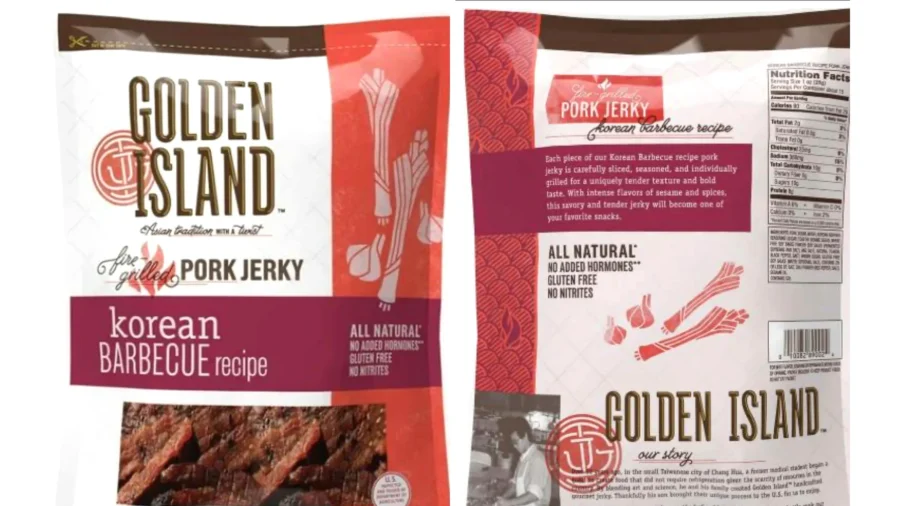
The recall applies to roughly 2,277,540 pounds of “Golden Island fire-grilled Pork Jerky Korean Barbecue recipe” sold in plastic pouches of 14.5 oz and 16 oz. The items were shipped to Costco and Sam’s Club retail sites across the United States.
The product withdrawal was categorized as a “High-Class I” recall, the highest of the three recall classifications set by the U.S. Department of Agriculture (USDA).
A Class I designation is issued “where there is a reasonable probability that the use of the product will cause serious, adverse health consequences or death,” according to FSIS.
The recalled items have “Best By” dates ranging from Oct. 23, 2025, to Sept. 23, 2026, with the establishment number “M279A” marked on the packages.
FSIS said it was concerned that some of the products may still be in customers’ pantries and asked people who have bought the items not to consume them. The affected products should either be disposed of or returned to the store, the agency said.
“The problem was discovered after the establishment received multiple complaints from consumers finding pieces of wiry metal in the pork jerky product. LSI, Inc. determined that the metal originated from the conveyor belt used in production,” the FSIS said.
“There have been no confirmed reports of injury due to consumption of this product. Anyone concerned about an injury should contact a healthcare provider.”
The Epoch Times reached out to LSI for comment and did not receive a response by publication time.
Multiple products have been recalled over the past few months due to concerns about contamination with foreign matter.
The company had received multiple customer complaints about wood contamination, including five that detailed alleged injuries.
Wood contamination typically comes from boxes, pallets, and buildings, the study said. Ingesting food contaminated with wooden pieces may cause cuts and infections, and people may require surgery to remove the fragments, according to the study.
“The use of wood in processing plants has practically been eliminated, and other materials like concrete, plastic, aluminum, and stainless steel have taken over due to the variety of food safety risks associated with wood,” the study said.
“Wood is not recommended to be used in food processing facilities during food production. However, wooden pallets are still occasionally used for shipping raw materials into the plant.”
Lawmakers have taken steps to strengthen food safety measures.
The Act directs the USDA to conduct a study examining the impacts of consolidating federal food safety agencies into a single agency. It also provides Congress with recommendations to improve food safety nationwide.
“Current food safety oversight is spread across multiple federal, state, and local agencies, which decreases efficacy, creates gaps, and slows response times to potential public health risks,” Cotton said.
“My bill is a commonsense step to expanding government efficiency and enhancing public health protection by unifying our food safety agencies.”