


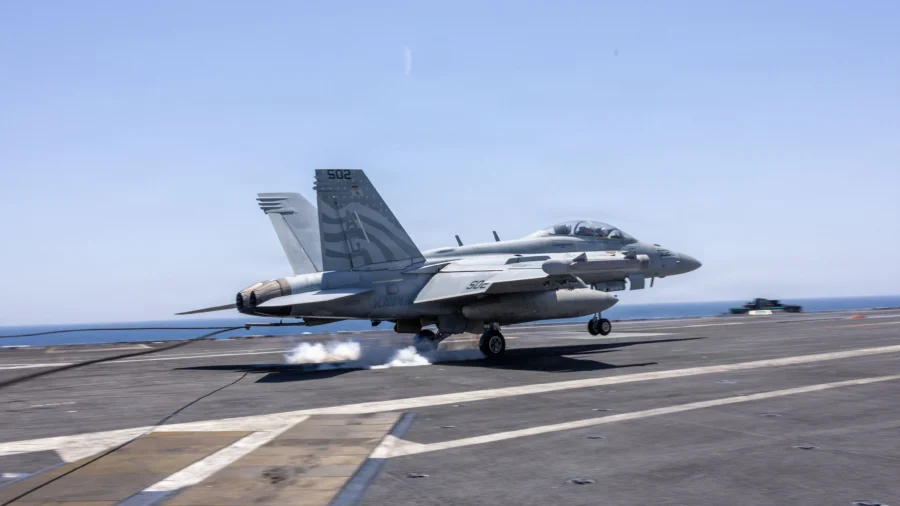
A U.S. fighter jet fired on a pair of crude oil tankers as they attempted to bypass a U.S. blockade on May 8.
U.S. Central Command (CENTCOM), which oversees military operations in the Middle East, announced that a U.S. Navy F/A-18 Super Hornet fighter jet launched from the aircraft carrier USS George H.W. Bush to intercept the two Iranian-flagged tankers, M/T Sea Star III and M/T Sevda. The tankers were unladen and sailing through the Gulf of Oman in an attempt to reach an Iranian port.
CENTCOM said the U.S. fighter jet fired precision munitions into the smokestacks of the two tankers to disable them and prevent them from reaching the Iranian port.
The U.S. military has been enforcing the blockade since April 13. President Donald Trump ordered the blockade after reaching a ceasefire with Iran on April 7.
U.S. forces have previously employed disabling fire as part of the blockade.
Guided-missile destroyer USS Spruance also fired its deck gun to disable the engine of another Iranian tanker on April 19.
While the U.S. military has been enforcing the blockade as a means of severing Tehran’s financial lifelines, Iranian forces have sought to maintain control over oceangoing traffic through the Strait of Hormuz. The strait acts as a key chokepoint along a major shipping lane for oil and gas exports, and traffic disruptions in the waterway have led to rising fuel prices.
At a May 5 Pentagon briefing, Air Force Gen. Dan Caine, chairman of the Joint Chiefs of Staff, assessed that more than 1,550 commercial ships remained in the Persian Gulf awaiting an opportunity to safely exit through the Strait of Hormuz.
This week, Tehran announced a new toll authority for exacting payment for commercial ships seeking to safely exit the Persian Gulf.
In a statement shared through state media on Friday, the Iranian military claimed it seized control of a tanker accused of maritime violations.
The U.S. government has said Iranian attacks on shipping since April 7 have yet to rise to a level that would collapse the current ceasefire.