

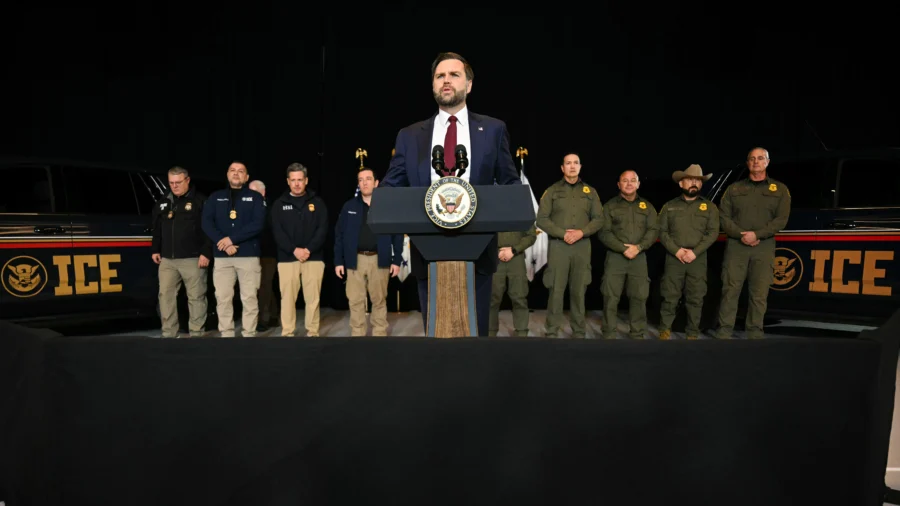
MINNEAPOLIS—Vice President JD Vance said that local authorities in Minneapolis need to cooperate better with federal officials in the city that has been hit hard by anti-ICE protests in recent weeks.
The event was held at Royalston Square, a former industrial building that is being repurposed into an entertainment-and-event center, in the city’s North Loop neighborhood.
It is about six miles away from the site where a federal agent fatally shot driver Renee Good on Jan. 7, after she drove her vehicle toward the officer. Officials assert that the officer acted in self-defense and suffered injuries after being struck by Good’s vehicle. The shooting sparked intensified protests against federal agents who are acting under U.S. laws authorizing arrests of illegal immigrants.The vice president said that as ICE attempts to enforce immigration law, state and local officials’ lack of cooperation has caused the need for more federal law enforcement officers to search larger areas for the criminal illegal immigrants they’re tasked with arresting.
Commenting on the results of his meetings with officials in Minneapolis, Vance said, “I learned today, the best way to facilitate reasonable enforcement of the law, but also to lower the chaos in Minneapolis, would be for state and local officials to cooperate now.”
Meanwhile, the state of Minnesota and the Twin Cities—Minneapolis and St. Paul—are suing the federal government, alleging that ICE enforcement tactics violate people’s constitutional rights and must discontinue.
According to the agency, the officers were blocked at each gas station where they attempted to use the facilities, and they were yelled at, stalked, spat on, blocked from exiting their vehicles, and physically attacked.
That operation began along with federal investigations into immigration and government-program fraud, focused largely on members of the Somali population.