
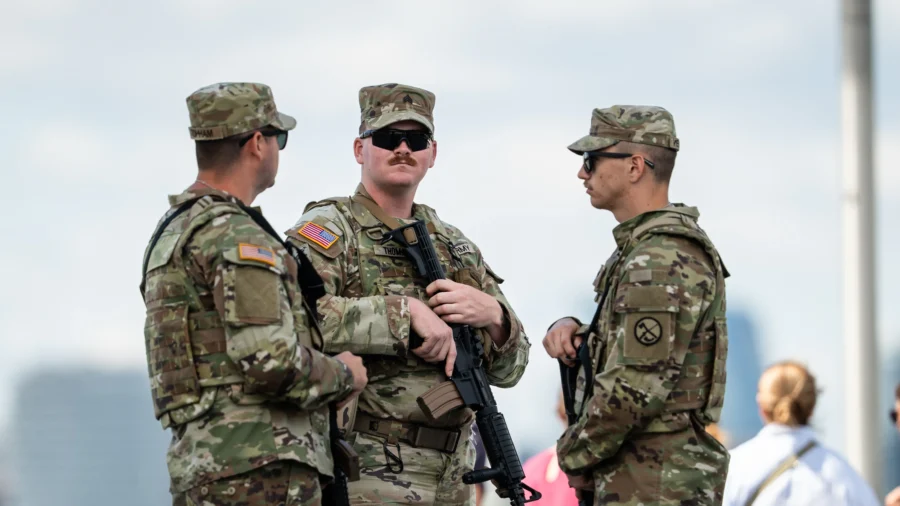
‘We’re Going In’: Trump Says He Will Send National Guard to Chicago

As president promises federal action, Mayor Brandon Johnson and Illinois Gov. JB Pritzker take steps to oppose what Pritzker calls 'an invasion.'
Published: 9/2/2025, 10:41:54 PM EDT

President Donald Trump confirmed on Sept. 2 that he decided to deploy the National Guard to Chicago to combat crime, but did not specify when that would happen.

“Well, we're going in,” he told reporters. “I didn't say when we're going in.”

This decision came after more than 50 people were shot and eight people were killed in the Second City during the recent Labor Day weekend.

“The last two weekends were similar,” Trump wrote on Truth Social, referring to police reports. “Chicago is the worst and most dangerous city in the World, by far,” and Illinois Gov. JB Pritzker “needs help badly, he just doesn’t know it yet.”

“I will solve the crime problem fast, just like I did in DC. Chicago will be safe again, and soon,” the president said.

Trump deployed the National Guard in Washington, D.C., and ordered the federal government to intervene in the city’s law enforcement. The White House said on Aug. 25 that more than 1,000 arrests had been confirmed, and no homicides had been reported since the federal government takeover.

“D.C. was a hellhole,” Trump said during remarks in the Oval Office on Aug. 22. “But now it’s safe.”

Now, he looks to take that strategy to other cities, including Baltimore and Chicago, but he did not specify when he would do so.

In 2024, Chicago had 573 homicides, more than in any other U.S. city, according to Wirepoints, an independent Illinois research organization.

Later on Tuesday, Trump told reporters in the Oval Office that “Chicago is certainly going to be high” on the list of places where federal assets will be deployed to curb crime. He said he would “love” to have a call with Illinois Gov. JB Pritzker and suggested the Democratic governor ask for help.

Trump's comments were made as Chicago Mayor Brandon Johnson announced over the weekend that he was taking action against federal immigration enforcement.

“I am signing an executive order that directs all of our City’s departments to protect Chicagoans and not collaborate with federal overreach,” Johnson said in an Aug. 30 post on X.
The mayor’s order bars city police from assisting federal agents in immigration or joint patrols, calls on federal officers to identify themselves and wear body cameras, and directs city departments to explore legal and legislative steps to resist federal actions. It also urges Trump to “stand down” from deploying troops.
Over the weekend, Pritzker told CBS News that he doesn't want troops sent to Chicago and that he would consider it "an invasion." He accused Trump of acting in an authoritarian manner.

A federal judge on Sept. 2 ruled that the Trump administration violated federal law by using U.S. military assets in Los Angeles in June in response to riots that broke out as federal agents conducted a crackdown on illegal immigration.

President Donald Trump and Defense Secretary Pete Hegseth ordered California National Guard members and U.S. Marines to protect the agents. The use of federal troops was a breach of the Posse Comitatus Act, U.S. District Judge Charles Breyer ruled.

Enacted in 1878, the Posse Comitatus Act generally blocks the use of federal troops to carry out domestic law enforcement.

Breyer, who serves on the San Francisco-based U.S. District Court of California's Northern District, also ordered the Trump administration to stop deploying troops to Los Angeles. He put the ruling on hold until Sept. 12, and the Trump administration likely will appeal.

“The evidence at trial established that Defendants systematically used armed soldiers (whose identity was often obscured by protective armor) and military vehicles to set up protective perimeters and traffic blockades, engage in crowd control, and otherwise demonstrate a military presence in and around Los Angeles. In short, Defendants violated the Posse Comitatus Act,” Breyer wrote in a 52-page opinion on Sept. 2.

Trump had ordered 4,000 National Guard and 700 active duty U.S. Marines to Los Angeles. California Gov. Gavin Newsom's administration filed a lawsuit against the administration, seeking to rescind the deployment.

Attorneys for the Trump administration have argued that the president has "every right under the Constitution" to call the National Guard and Marines to stop "lawless violence directed against enforcement of federal law."
T.J. Muscaro and Reuters contributed to this report.