


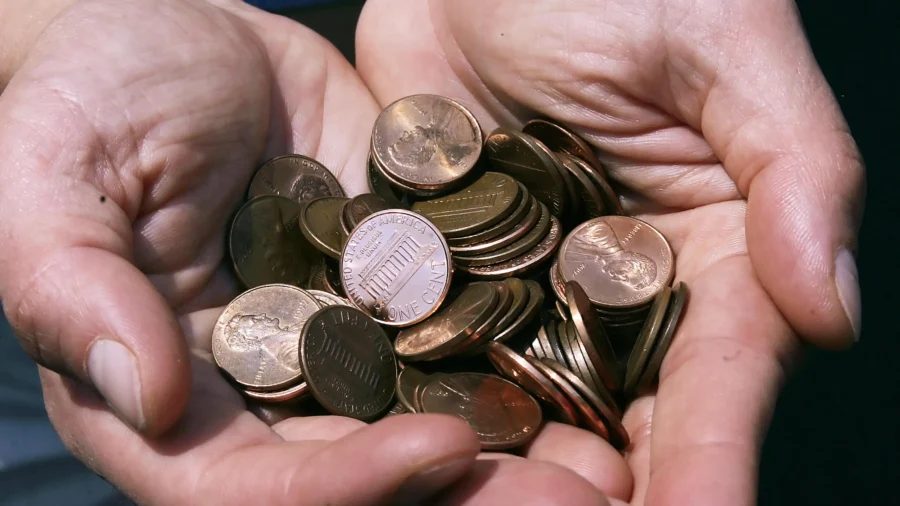
The U.S. Mint is preparing to end production of the penny, a move that marks a significant change in American coinage and is expected to deliver millions in annual savings, according to the Treasury Department.
The Mint made its final order for penny blanks and will cease production once those supplies are depleted, a Treasury official confirmed to Reuters on May 22.
President Donald Trump announced in February 2025 that he had directed the Treasury to stop producing new pennies, calling the practice “wasteful.”
A Coin With Deep Roots, But Diminishing Use
The penny, one of the first coins produced by the U.S. Mint after its establishment in 1792, remains the most produced coin made by the Mint, which created 3.2 billion of them last year—more than half of all new coins produced.Despite their abundance, pennies are underutilized in daily transactions. There are about 114 billion pennies in circulation, totaling $1.14 billion, the treasury said.
Critics of the move, however, highlight the coin’s role in charity drives and its lower production cost compared to the nickel, which now costs almost 14 cents to mint.
Mark Weller, executive director of Americans for Common Cents, said, “there has been an evolution over the past six months that inevitably the production of the penny will be halted.”
He said the Treasury should look for a cheaper way to make the nickel, since demand for it is likely to increase once the penny is eliminated. “It’s incumbent on Treasury to come up with a cheaper way to make the nickel,” Weller said. “Let’s make sure we’re making our coins as least expensively as possible and maintaining the option to use cash in transactions.”
Jay Zagorsky, a professor at Boston University, supports ending penny production but cautions that without legislation requiring rounding in pricing, demand for nickels—which are even more expensive to produce—could rise.
“If we suddenly have to produce a lot of nickels—and we lose more money on producing every nickel—eliminating the penny doesn’t make any sense,” Zagorsky said.
How Pennies Are Made
The U.S. Mint’s process for making coins involves several steps, including blanking, annealing, washing, upsetting, striking, and packaging. For pennies, the Mint purchases blanks—flat metal discs—which are then processed and struck with designs at facilities in Philadelphia and Denver.For pennies, these blanks are produced by private manufacturers and delivered to the Mint, already cut to the correct size and composition. The blanks are made primarily of zinc, coated with a thin layer of copper to give the penny its distinctive color.
Before striking, the blanks undergo annealing—a heat treatment that softens the metal, making it easier to imprint the coin’s design. During annealing, the blanks are heated in a furnace and then slowly cooled, which helps prevent cracking or other imperfections during the striking process. After annealing, the blanks are washed and dried to remove any residue.
Next, the blanks are sent through an upsetting mill. This step raises a rim around the edge of each blank, preparing it for the striking process. The raised rim helps contain the metal during striking, ensuring that the coin’s design is sharp and well-defined. Once the coins pass inspection, they are counted, weighed, and shipped to Federal Reserve Banks for distribution.