


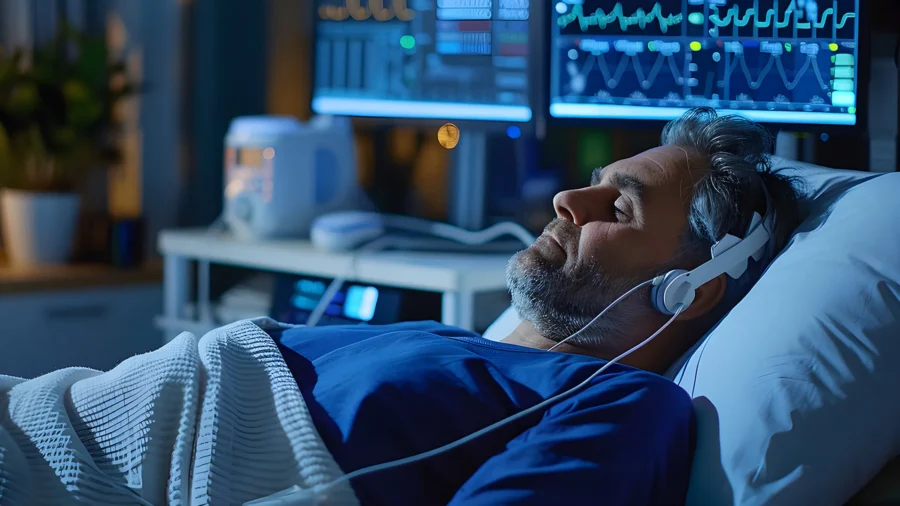
It’s in slow-wave (or deep) sleep that the brain’s trash disposal process is underway, says internist and sleep medicine physician, Dr. Roger Seheult.
Large-amplitude slow waves cause a pulsation of the lymphatic system around the brain, taking away its impurities, including discarded proteins, says Seheult.
However, a lack of slow-wave sleep may lead to these proteins building up, as seen with the buildup of amyloid protein in the brain that is linked to Alzheimer’s disease.
Seheult, who is also specialized in pulmonary diseases and critical care medicine, is an associate professor of medicine at UC Riverside.
On “Vital Signs with Brendon Fallon,” he reveals ways to sync our internal clocks to the sunrise–sunset rhythm of the day to get more slow-wave sleep—and a better night’s rest overall.
These strategies include varying our exposure to light before bed and in the early morning, supporting our bodies’ natural cool-down process during sleep, and optimizing the sleeping environment.
“Nine or ten o'clock at night is when melatonin starts to be secreted from the pineal gland as a signal to the entire body that things are going to be shutting down and you're going to be going to bed,” says Seheult.
Exposing your eyes to light, especially from devices, at night is going to delay the circadian rhythm, he says. “So instead of falling asleep at nine, ten, or eleven o’clock … you’re getting tired now at twelve or one o’clock in the morning.”
How might a warm shower before bed influence sleep? How might restricting sleep time lead to an improved sleep routine?
Seheult reveals easy steps to reset the body’s clocks for better sleep on “Vital Signs.”
—----------------------------------------------------------------------------------------------------------------------------------------------
Get notice of new?Vital Signs videos:
===================================================================================